About Neodiprion lecontei (Fitch)
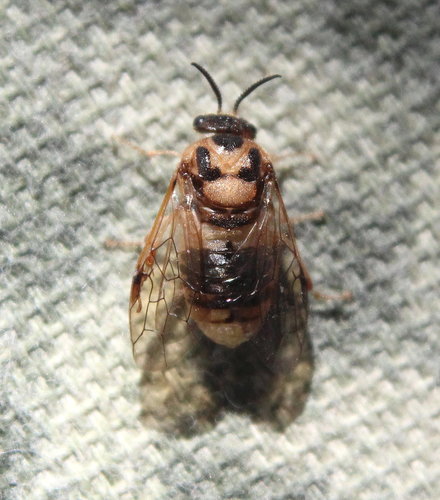
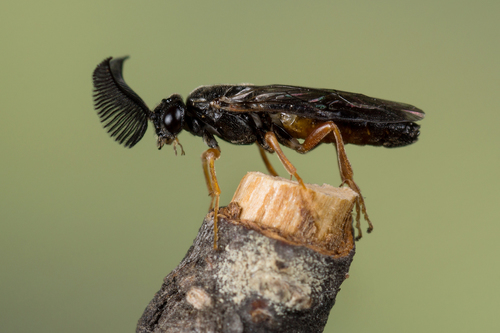
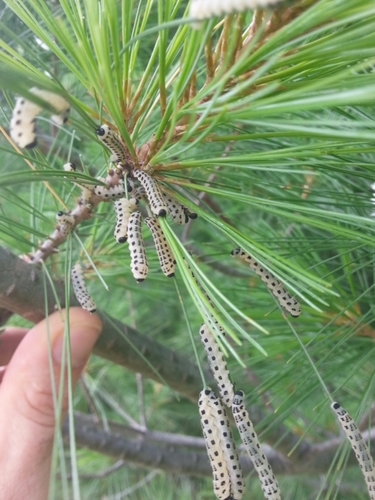
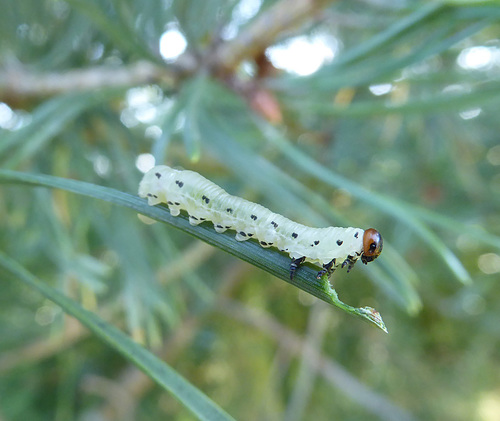
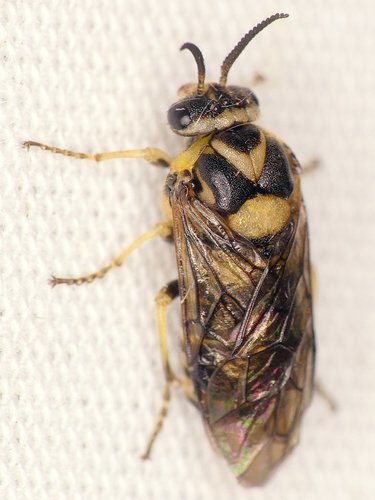
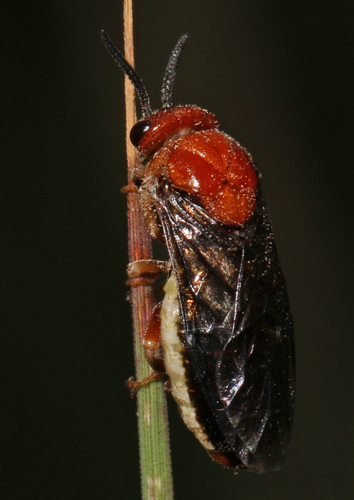
Adults of Neodiprion lecontei have membranous wings and a broad waist, and range in length from 5 to 8.5 mm (0.20 to 0.33 in), with males somewhat smaller than females. Males have feathery antennae, while females have 19-segmented serrated antennae. Males are entirely black and more slender, whereas robust females have reddish-brown heads and thoraxes, mostly black abdomens that sometimes have white markings on the sides. The larvae resemble lepidopteran caterpillars: young larvae are whitish with brown heads, while older larvae are yellowish-green with brown heads and up to eight longitudinal rows of black spots. Larvae have three pairs of legs at the front end, and six to seven pairs of prolegs at the rear end. Neodiprion lecontei is native to eastern North America. Its range extends from southeastern Canada west to the Great Plains, and south to Texas and Florida. Larvae of this species feed on many members of the pine family. In the northern part of its range, it favors hard or yellow pines such as Pinus banksiana and Pinus resinosa. Further south, it prefers Pinus echinata, Pinus taeda, Pinus elliottii and Pinus palustris. Trees shorter than 5 m (16 ft) are frequently attacked, and pine plantations established in the 1930s saw this insect reach pest proportions. Other host trees that larvae feed on include Pinus virginiana, Pinus strobus and Pinus sylvestris; if no other host is available, they will also feed on Picea abies, Cedrus deodara and Larix species. In the life cycle of Neodiprion lecontei, the adult female sawfly cuts slits into pine needles with her ovipositor, and lays one egg in each slit. Infested needles appear pale, with a banded appearance from the eggs. Eggs hatch after approximately four weeks. Young larvae feed on the sides of pine needles, leaving an uneaten central section that withers and dies; this section remains on the tree, creating a distinctive straw-like effect. Older larvae eat the entire needle before moving on to a new one. Larvae are gregarious, and can completely strip all needles from whole branches and entire trees. If a tree is fully defoliated, larvae move as a group to a neighboring tree, or may start feeding on the soft bark of twigs. When larval development is complete, larvae drop to the ground and spin cocoons in needle litter or underground. They overwinter here as prepupae, then pupate in spring, and bite their way out of one end of the cocoon to emerge as adults. Some individuals may not emerge as adults until the following year, due to an extended diapause. In the northern part of the species' range, there is one generation per year; further south, there may be two or three, sometimes overlapping, generations each year.