About Neocussonia umbellifera (Sond.) Hutch.
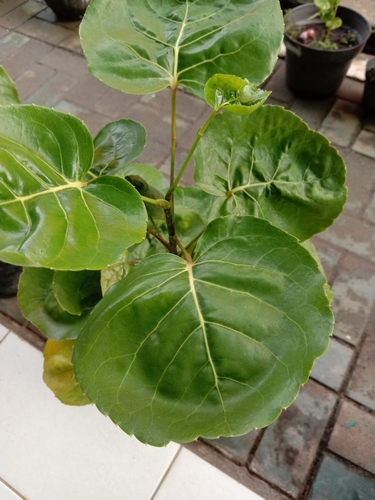
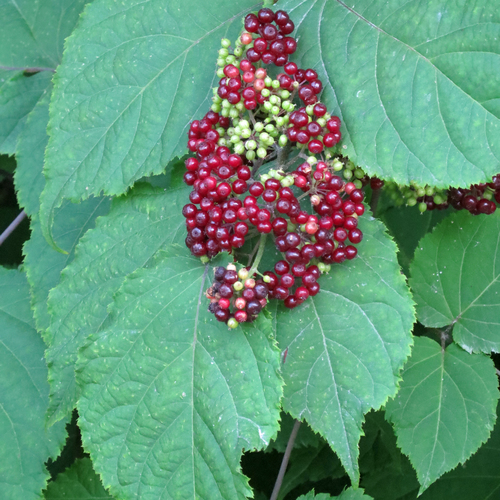
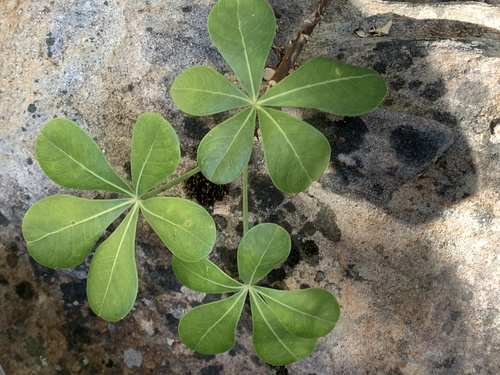
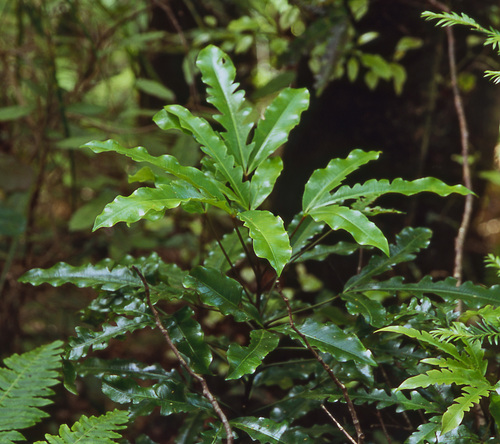
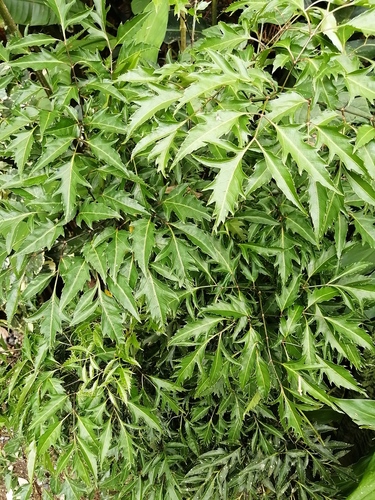
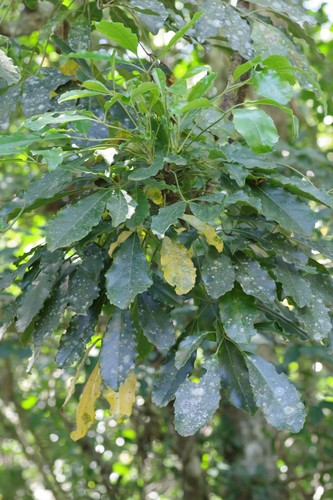
Neocussonia umbellifera (Sond.) Hutch. prefers regions with higher rainfall, and grows at elevations up to 2000 metres above sea level. It typically has a clean, unbranched stem in its lower half, and is much-branched in its upper half. Its trunk can reach up to about 600 millimetres in diameter. The species has dense, tufted foliage that is dark green on the upper leaf surface and paler on the lower surface. Leaves are digitately compound, with 5 to 7 leaflets, and leaf stalks (petioles) around 250 millimetres long. Leaflets are oblong, with entire but undulate margins, and measure 10–15 centimetres long. They grow on short petiolules around 40 millimetres long. Leaflet tips are either emarginate with a terminal mucro or acute, while the leaflet base is cuneate, sometimes oblique. Small pale yellow flowers grow between January and May, arranged in umbels that form a somewhat umbellate terminal panicle. Fruits are small, globose, and up to 7 millimetres in diameter. They are red when mature, and appear from June to August. This species is suitable for use as Bonsai, the Japanese art of growing stunted trees in containers. A dichloromethane extract of N. umbellifera yields the active compound betulin, which shows some antiplasmodial activity. In traditional medicine, decoctions and infusions made from the leaves and bark have been used to treat indigestion, rheumatism, colic, insanity, and malaria. Roots are used as a diuretic and laxative, and to treat malaria, venereal diseases, and nausea. Bark extracts are also used to treat stomach ulcers. Compounds from the plant family Araliaceae display a wide range of pharmacological properties, including antifungal, antimalarial, anti-inflammatory, anti-brain tumour, and antibacterial activity.