About Neoclinus blanchardi Girard, 1858
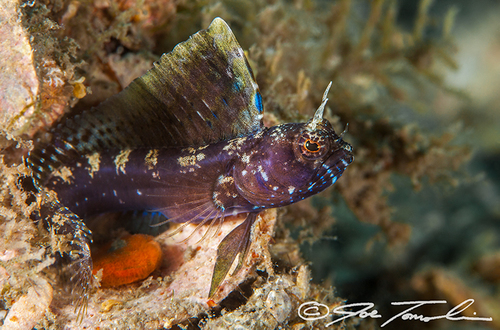
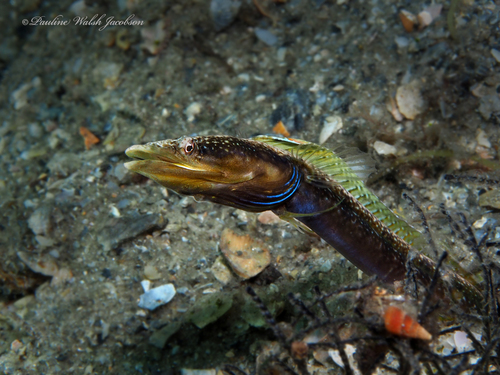
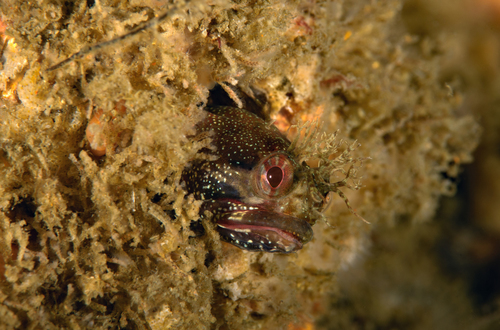
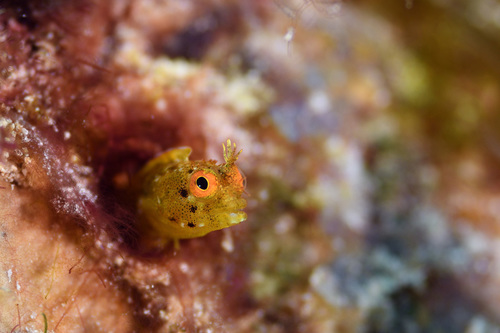
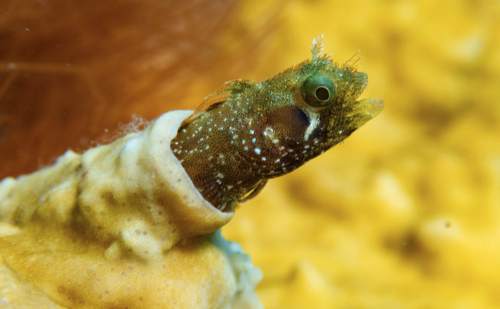
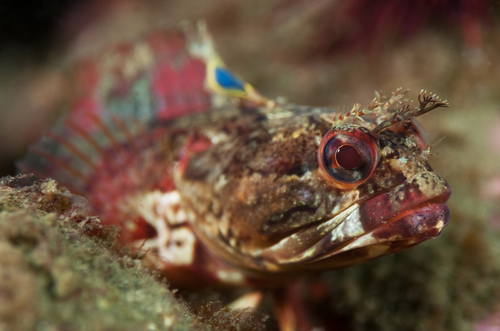
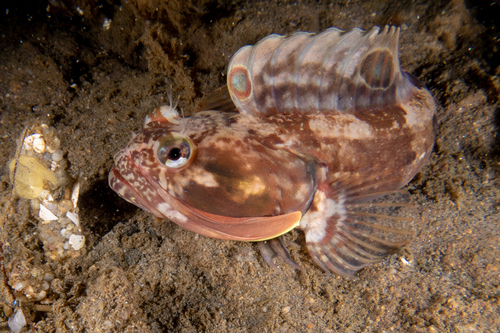
The sarcastic fringehead, Neoclinus blanchardi, is a small, hardy saltwater tube-blenny known for its large mouth and aggressive territorial behavior, which inspired its common name. The name 'fringehead' refers to the distinctive ruff of tissue that surrounds the fish's neck. Its specific scientific epithet honors Dr. S. B. Blanchard of San Diego, California, who collected specimens of this blenny and shared them with Charles Frédéric Girard, who formally described the species in 1858. Sarcastic fringeheads are found in the Pacific Ocean off the coast of North America, ranging from San Francisco, California to central Baja California. They occur at depths between 3 and 73 meters (10 to 240 feet). This species belongs to the genus Neoclinus, whose members live on both sides of the North Pacific Ocean but are absent from the waters between these two regions. This distribution pattern suggests a historical dispersal event from the genus's origin in the eastern Pacific. Sarcastic fringeheads inhabit sandy and muddy bottoms below the low tide line. They typically back into objects and cavities such as shells, burrows, and crevices, leaving only their heads exposed. They are also known to live in discarded man-made objects, including bottles and soda cans. When two sarcastic fringeheads fight over territory, they wrestle by pressing their distended mouths against each other in a motion that resembles kissing. They continue pressing until one fish is able to bite the other's head. This interaction allows them to determine which fish is larger, which in turn establishes dominance. This behavior is thought to be male-male competition for shelter, a resource critical to the species' survival in their highly competitive habitats. If a sarcastic fringehead loses a wrestling match to an intruder, it is displaced from its shelter and must search for a new one. This search uses significant time and energy that the fish could otherwise spend on foraging or mating. The time spent searching for a new shelter also increases the displaced fish's risk of predation, as it is more vulnerable while moving to find a new home. The outcome of these wrestling matches can be considered a stochastic process, where every encounter produces a range of results that impact the individual fish's daily energy use and survival. The species' cranial adaptations, especially its enlarged jaws, play a key role in territorial displays used to compete for space in its rocky, subtidal habitats. The timing of developmental changes in the sarcastic fringehead's body form directly influences how well it can perform these aggressive displays. Younger individuals have less intense aggressive displays due to their smaller size and less developed jaw structures, while mature adults have amplified aggressive displays as they age. Though gaping displays are common across other Neoclinus species, the sarcastic fringehead has a unique display that involves lateral flaring of its unusually long maxillae. Divers have observed that despite the fish's small size, which is typically between 6 and 10 inches (150 and 250 mm), its territorial aggression and jaw-flaring display can be surprisingly intense during encounters. The sarcastic fringehead has significant maxilla mobility due to the maxilla's conical shape and deep socket. Flaring of the maxillary membranes and other morphological features is critical for visual communication between members of the species. Sarcastic fringeheads have noticeably different aggressive displays compared to other fringehead species. This suggests that ecological pressures like increased competition for resources have shaped this species' unique behavioral traits. The evolution of the sarcastic fringehead's aggressive display is a clear example of heterochrony, where changes to the timing and rate of development produced enhanced features that amplify the fish's territorial and mating behaviors. For reproduction, the female lays approximately 3,000 eggs under rocks, in clam burrows, or in other enclosed sheltered spaces. After spawning, the male plays a critical role in guarding and fanning the eggs until they hatch. The eggs have a diameter of roughly 0.9 to 1.5 millimetres (0.035 to 0.059 in), and their filaments help them adhere to the nest surface and to each other. When larvae hatch, they measure approximately 3 millimetres (0.12 in) in length. Sarcastic fringeheads spawn between January and August, at depths ranging from 14 to 27 meters (45 to 90 feet). The genital papilla, located at the back of the urogenital opening, differs between the sexes: males have a pointed papilla, while females have a rounded one. Sarcastic fringeheads can live up to a maximum of about 6 years, which shapes their reproductive strategies.