About Neocirrhites armatus Castelnau, 1873
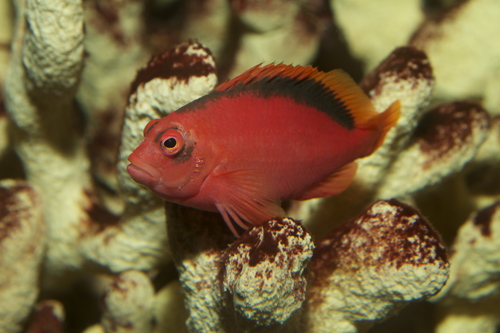
The flame hawkfish, Neocirrhites armatus Castelnau, 1873, has a very deep, highly compressed body. Its standard length is between two and two and a half times its body depth, and it has a moderately long snout. The mouth holds an outer row of canine teeth and an inner row of much smaller villiform teeth. The canines are notably larger at the front of the upper jaw and the side of the lower jaw, and there are no teeth on the palatine. A tuft of cirri and a flap sit on the posterior edge of the anterior nostril. At least the upper three-quarters of the preoperculum has large serrations. The dorsal fin has 10 spines and 13 soft rays, while the anal fin has 3 spines and 6 to 7 soft rays. The dorsal fin spines are short, each spine tip has a tassel of cirri, and the membranes between the spines are only weakly incised. The caudal fin is weakly rounded. The six lowest pectoral fin rays are unbranched and robust, and the longest of these rays do not extend past the tips of the pelvic fins. This species reaches a maximum total length of 9 centimetres (3.5 inches). Its body is bright red, with black patches around the eyes and beneath the dorsal fin. The flame hawkfish is distributed in the western Pacific Ocean. Its range extends north to the Ryukyu and Ogasawara Islands of Japan, east across the Pacific to the Pitcairn Islands, and south to the Great Barrier Reef off Queensland. This species can be found at depths as great as 25 m (82 ft), but it is most commonly found between 10 and 15 m (33 and 49 ft). It is a common species on reef fronts exposed to tidal surge, and on underwater terraces.