About Neocicindela latecincta (White, 1846)
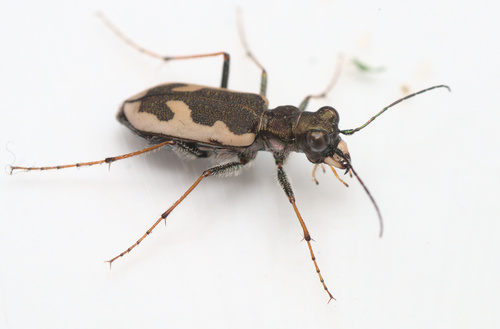
Neocicindela latecincta (White, 1846), also known as the wide-banded tiger beetle, is an unusually small species of tiger beetle. Adult individuals of this species have a body length between 11 and 13.3 mm. The head and pronotum of the beetle are dark brown. The elytra (forewings) are mostly dark brown across their central area, with a wavy light-yellow patch on the outer edge of each elytron. The species has an oblique band that is wider than the corresponding band found in Neocicindela tuberculata; this band does not extend past the base of the apical lunule, which is a crescent-shaped marking at the tip of the elytron. A row of small or poorly developed green foveae (small depressions in the beetle's exoskeleton) runs along the elytra. The dark areas of the elytra, pronotum, and top of the head have a green metallic lustre, which is a shiny appearance produced by the structure of the exoskeleton rather than by pigment. The tarsal claws, which are small hook-like structures at the end of an insect's legs, are approximately five times shorter than the fifth tarsal segment. The tarsi and tibiae are mostly pale in colour. The wide-banded tiger beetle is endemic to the South Island of New Zealand. It has been recorded in areas near the Taieri River and Estuary, and may also occur on clay banks in the Otago region. Māori have used larvae of Neocicindela species as popular fishing bait.