About Neochmia phaeton (Hombron & Jacquinot, 1841)
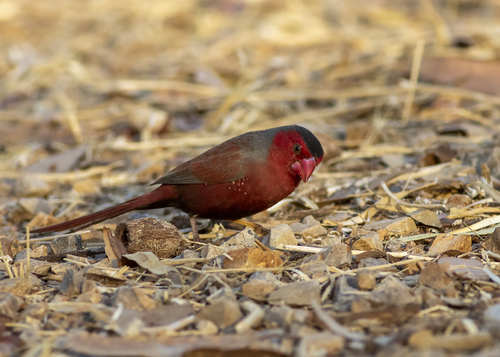
The crimson finch, scientifically named Neochmia phaeton (Hombron & Jacquinot, 1841), is a relatively small bird. It measures around 13 cm long and weighs just 13 grams, which equals 0.46 ounces. Its most distinctive features include a bright crimson color, a long tail, and white specks running across the sides of its body, with grey shading around the neck. This species is sexually dimorphic: females are slightly paler in color, but males and females share the same general plumage pattern. Males differ from females by having longer tails, longer bills, and being larger and heavier overall. Three weeks after fledging, juvenile crimson finches moult into adult plumage; this moult is only partial, and juvenile greater primary coverts are retained. Crimson finches are mainly distributed across northern Australia, with some populations living in New Guinea. They are common in the Kimberley region of northwestern Australia, but less widespread in northeastern Australia's Queensland area. Their preferred habitats are areas with tall, dense grasses, and they typically live near wetlands with riparian vegetation that supports abundant Pandanus trees. For nesting, they build nests from shrubs and dry brush, most often at the base of Pandanus trees, and nests are also commonly placed inside hollow tree limbs. Crimson finches are well known for their aggressive behavior, which earned them the nicknames "blood finch" and "killer finch". Males act aggressively toward both conspecifics and other bird species, regardless of the other bird's age, coloration, or body size. Aggressive encounters vary greatly, as they are primarily individual interactions. When females are the primary defenders of a nest, they also show similar aggressive behavior toward intruders, though little detailed information is known about female aggression. The primary mating system of breeding crimson finches is monogamy, and there are roughly 4 to 5 breeding pairs per 100 meters. The species is non-territorial, and individuals place their nests close to the nests of other birds. They mostly nest in areas centrally located to riparian vegetation and rivers. Unlike other southern passerines that lay small clutches, crimson finches have extremely large clutch sizes. This difference may be explained by high rates of nest predation from reptiles, which locate nests using their sense of smell. For food, crimson finches primarily feed on grass seeds, including seeds of Xerochloa imberbis, a type of rice grass, and they also eat insects. This species has high survival rates ranging from 70 to 96%, and individuals can live 5 years or longer.