About Neochelidon tibialis (Cassin, 1853)
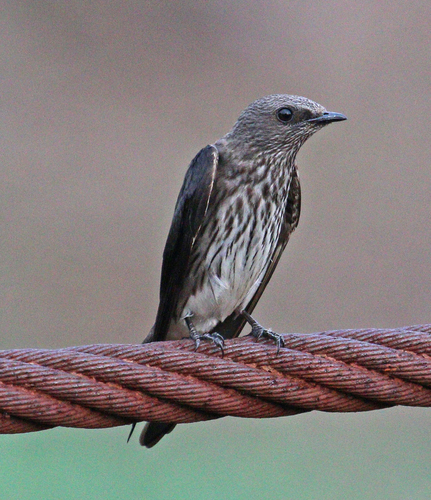
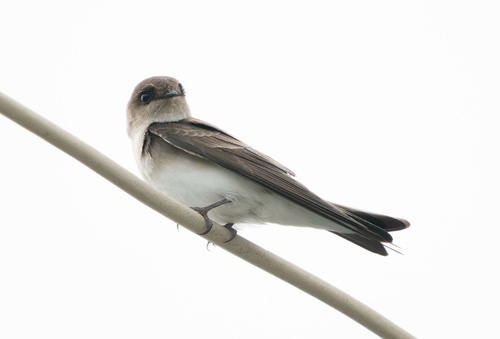
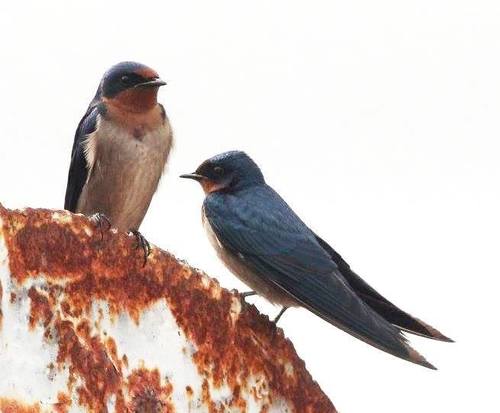
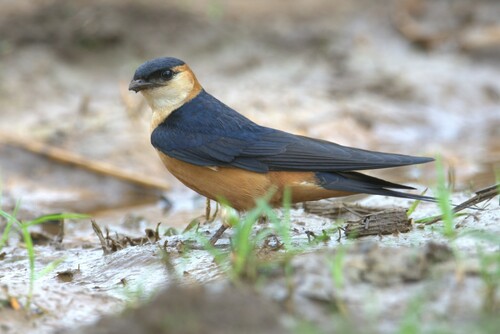
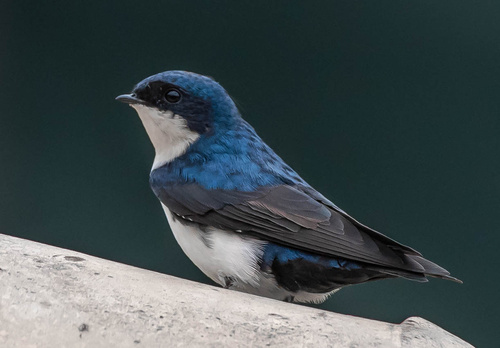
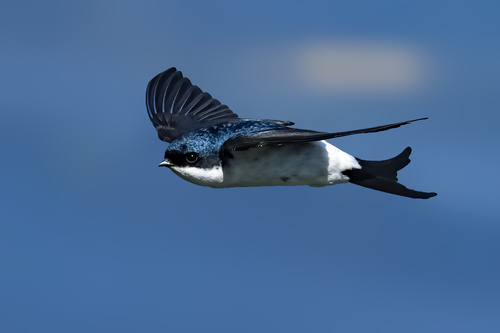
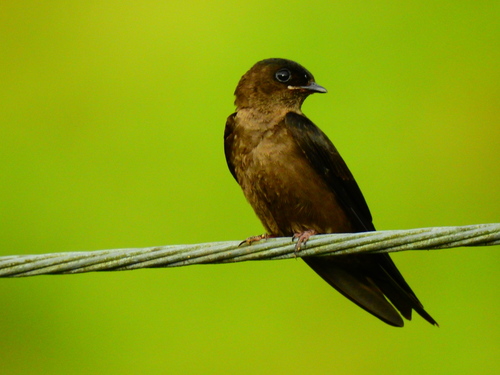
Neochelidon tibialis, commonly called the white-thighed swallow, averages about 12 cm (4.7 in) long and weighs 8.5 to 14 g (0.30 to 0.49 oz). Males and females have identical plumage. Adults of the nominate subspecies have a brownish black head with a faint green sheen, black lores, and gray-brown cheeks and throat. Their back is brownish black with a faint green sheen, and their rump is gray-brown. They have a slightly forked, brownish black tail. Most of their wings are brownish black, with slightly lighter tips on the greater coverts and tertials. Their underparts are gray-brown, with the characteristic white feather tufts on their lower legs that give the species its common name. Subspecies A. t. minima is smaller and overall darker than the nominate subspecies. A. t. griseiventris is larger and glossier than the nominate, with a grayer rump and grayer underparts. All subspecies typically have dark brown irises, bills, and legs and feet, though a small number of A. t. minima individuals have different coloration. The white-thighed swallow has a disjunct distribution, with each of its three subspecies occupying a separate geographic range. A. t. minima is found from Coclé Province in central Panama south through western Colombia into western Ecuador, reaching as far south as western Azuay Province. A. t. griseiventris ranges from southern Bolívar and eastern Amazonas states in Venezuela south across a small area of northwestern Brazil, eastern and southern Colombia, eastern Ecuador, and eastern Peru into northern Bolivia; it also extends east across Brazil south of the Amazon River, with a separate population from extreme eastern Guyana east through Suriname into French Guiana. The nominate subspecies A. t. tibialis occurs in southeastern Brazil, mostly from southern Bahia south to eastern São Paulo state, with recorded observations as far north as Pernambuco. The white-thighed swallow primarily inhabits edges and clearings of lowland tropical evergreen forest. It can also be found in more open landscapes with scattered trees and along rivers. Across its entire range, it occurs from sea level up to approximately 1,200 m (3,900 ft) in elevation. It reaches 1,100 m (3,600 ft) in Colombia, 800 m (2,600 ft) in western Ecuador, 1,250 m (4,100 ft) in eastern Ecuador and Peru, 900 m (3,000 ft) in Venezuela, and mostly up to 1,000 m (3,300 ft) in Brazil with local occurrences at higher elevations.