About Neobernaya spadicea (Swainson, 1823)
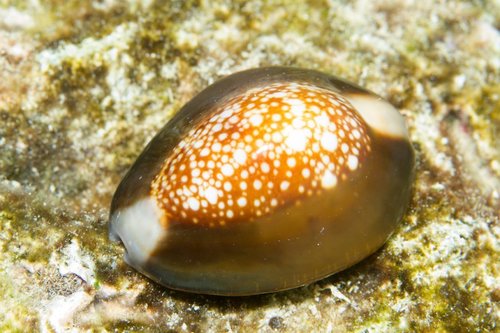
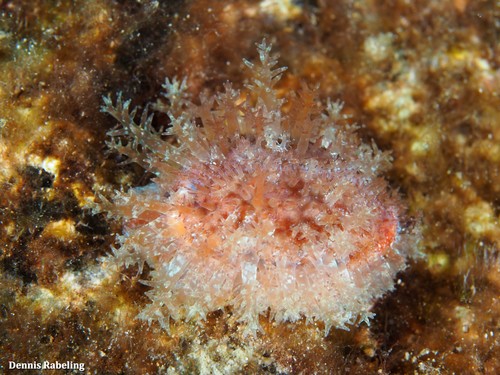
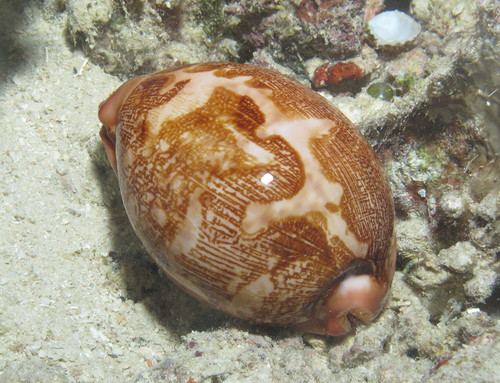
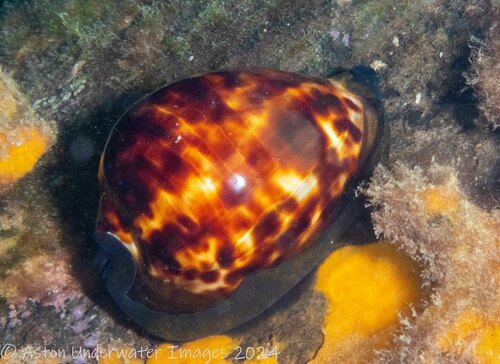
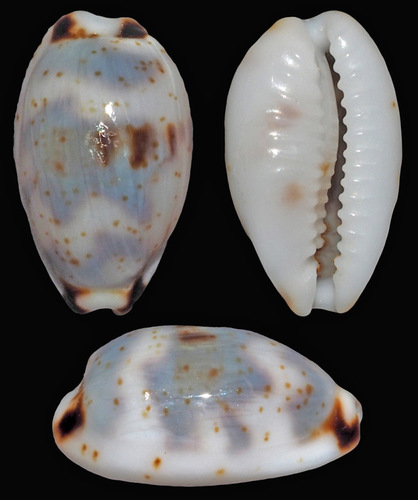
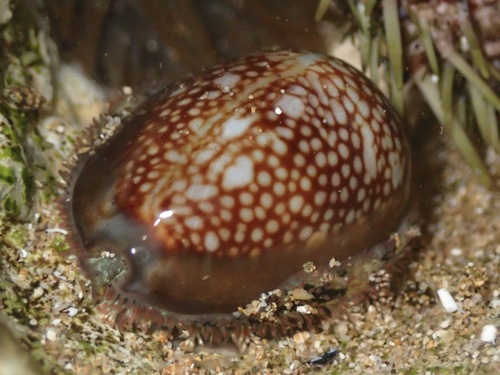
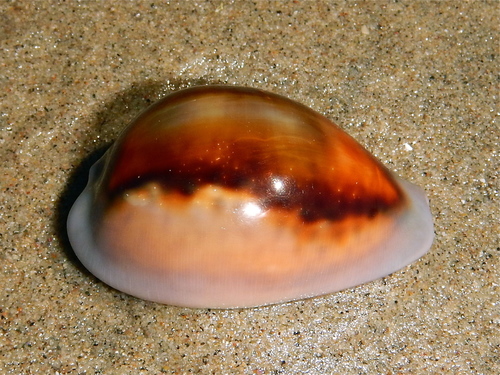
This species, scientifically named Neobernaya spadicea (Swainson, 1823), is commonly called the chestnut cowrie. The top of its shell bears a large, irregular caramel-colored spot outlined by a dark brown border. The remaining area of the shell, including the entire underside, is white. A narrow aperture lined with small teeth runs the full length of the shell’s underside. Shell growth stops once the cowrie reaches its adult form. When the animal is undisturbed, its orange-spotted mantle extends around the outer surface of the shell, and can fully cover the shell when fully extended. The shell’s glossy appearance comes from enamel secreted by the edges of the mantle. The repeated extension and retraction of the mantle buffers and polishes the shell while new enamel is deposited. The foot of this species is white. Adult shells measure between 40 and 65 mm in size. This is the only cowrie species native to the eastern Pacific Ocean. Its distribution ranges along intertidal zones from Monterey, California to Isla Cedros, Baja California. It is common in Southern California, particularly around the Channel Islands, and rare in the part of its range north of Santa Barbara, California. It inhabits kelp beds and rocky surfaces in intertidal and subtidal zones, reaching depths of up to 45 m, and is most often found hidden under rocks and in protected crevices. Chestnut cowries lay batches of eggs during the summer. Each batch contains roughly 100 egg capsules, and each egg capsule holds several hundred individual eggs.