About Nemophora degeerella (Linnaeus, 1758)
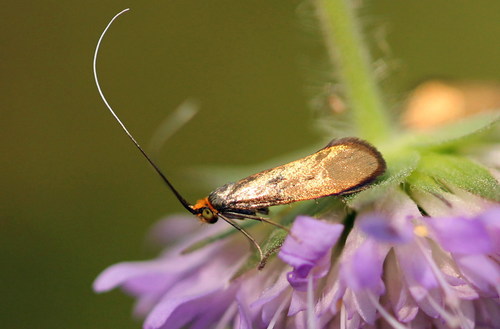
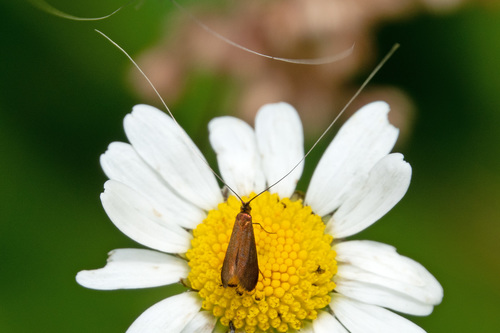
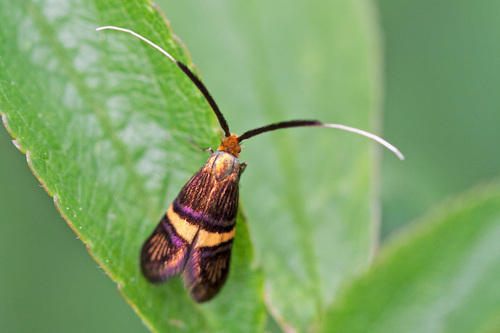
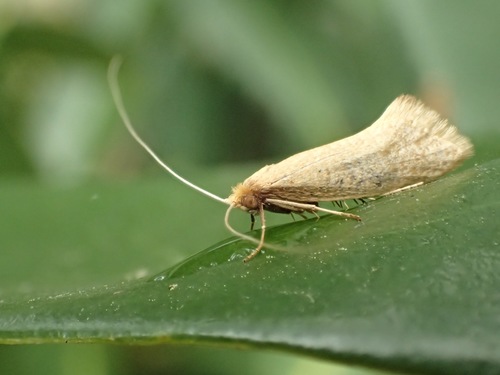
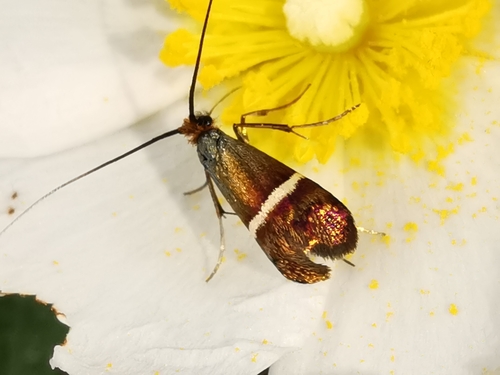
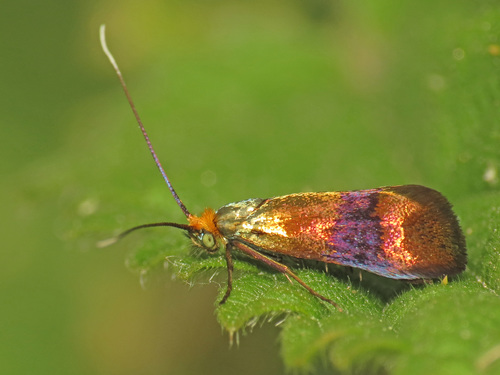
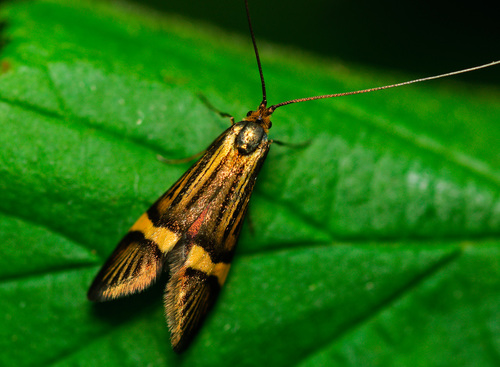
Nemophora degeerella (Linnaeus, 1758) has distinct sexual dimorphism in size and antennae. Males have a wingspan of 18–20 millimetres (0.71–0.79 in), while females have a wingspan of 15–18 millimetres (0.59–0.71 in). The head is dark brown, covered in dark and yellow hair-like scales. The thorax has a bronzy golden shine. Forewings are shiny bronzy golden yellow or shiny ochreous, marked with longitudinal dark brown and lead-gray blueish-violet shining streaks. A yellow transversal band crosses the entire forewing, framed by two lead-gray blueish-violet shining stripes that each have a dark brown border. Three longitudinal lead-gray, blueish-violet shining stripes located in the basal part of the wings do not reach the transversal fascia. Hindwings are brownish gray. Males of this longhorn moth have filiform antennae that reach up to five times their body length, while females have much shorter antennae. In females, the basal part of the antennae is thickened with black scales, and the antennae tip is white. Nemophora degeerella is very similar to Nemophora congruella, but N. congruella is slightly smaller, its forewing markings are bright yellow, and its yellow band is located closer to the forewing base. Female N. congruella lack the beard-like scales found on the basal part of the antennae of female N. degeerella. This species is also similar to Adela croesella, which is much smaller and more colorful, and has gray blueish-violet stripes that are at least as wide as the yellow central band. This species is present across most of Europe, and it is fairly common in north west Europe. Its habitat consists of damp deciduous forests, wooded lanes, and hedgerows.