About Nemophila maculata Benth. ex Lindl.
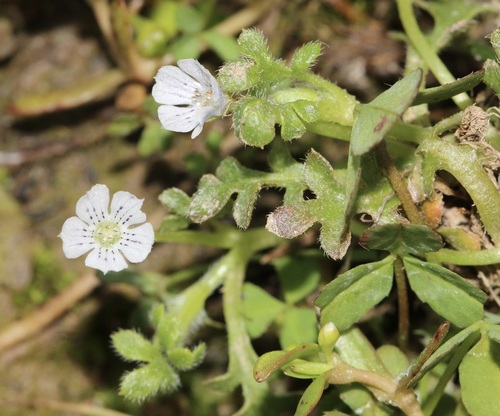
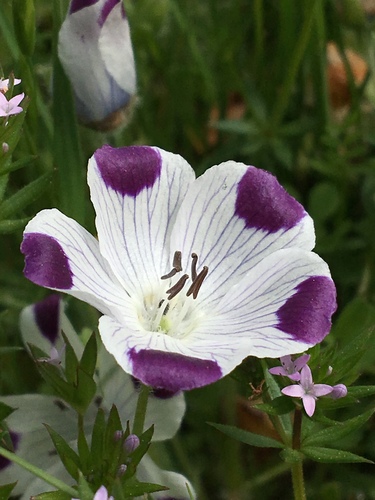
Nemophila maculata Benth. ex Lindl. is an annual herb that blooms in spring. Its leaves grow up to 3 centimeters long and 1.5 centimeters wide, and are split into several lobes that may be either smooth or toothed. The flowers are bowl-shaped, white with dark veins and dots, and the tips of the flower lobes carry purple spots. The corolla measures 1 to 2 centimeters long and up to 5 centimeters wide. The distinctive spots on its flowers give the species its common name fivespot, and these spots attract the plant’s primary pollinators: solitary bees. Both male and female solitary bees feed on the nectar of N. maculata, while females also collect pollen from the plant to feed their larvae. The plant’s seeds are greenish-brown, and may be either smooth or shallowly pitted. Each fruit produces up to 12 seeds. The full fruiting and seed development cycle of this species starts in spring and finishes in summer. This wildflower is endemic to California, where it grows on slopes at elevations between 20 and 1,000 metres (66 to 3,281 ft). It is most common in the Sierra Nevada, the Sacramento Valley, and the California Coast Ranges of the San Francisco Bay Area. It grows in a range of plant communities, including valley grassland, foothill woodland, and pine and fir forest. In cultivation, N. maculata is grown as a sown annual ornamental plant in traditional gardens, native plant gardens, and pollinator or wildlife gardens. It grows best in loose, evenly moist, well-drained soils, and needs full sun to part shade. It will self-seed when growing in optimum conditions.