About Nematopogon swammerdamella (Linnaeus, 1758)
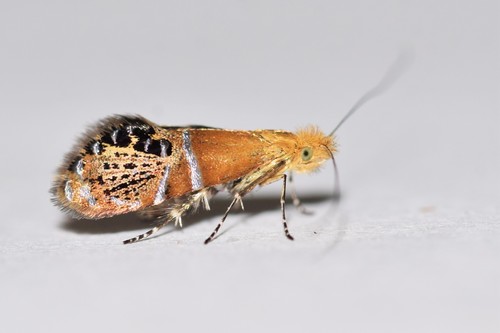
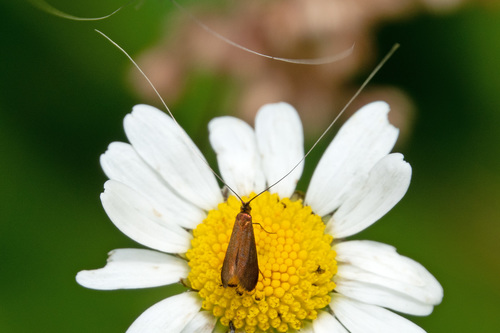
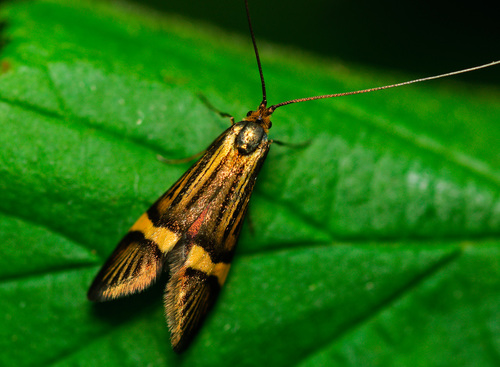
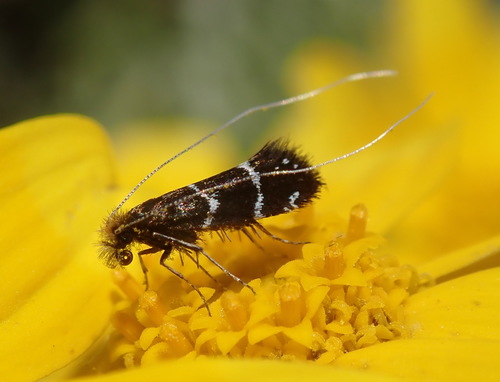
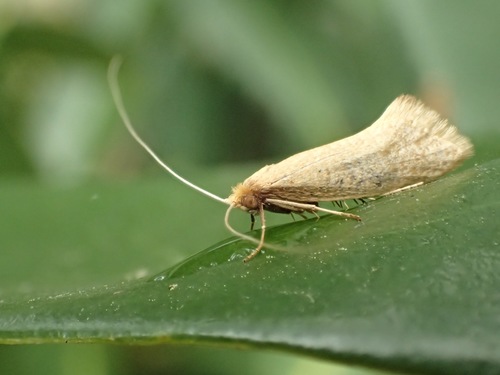
Nematopogon swammerdamella is a medium-sized brownish-yellow moth with long antennae. It is the largest Nematopogon species native to North Europe. It can be distinguished from other species in the same genus by its distinctly triangular forewings, which are more rounded in other Nematopogon species, and by its earlier flight period in spring. However, examining genitalia is usually required to identify the species with certainty. Its antennae are filamentous and yellowish: in males, they are about two and a half times as long as the forewing, while in females they are about 1.8 times as long as the forewing. The head, forebody, and forewing are ochre-yellow. The forewing is relatively wide, with a pronounced tip and hind corner that give it a distinctly triangular shape. The wing fringes are yellowish, and paler than the wing itself. The hindwing is grey with pale grey fringes, and its tip may be slightly brownish. Meyrick describes this species as having long, pale shining ochreous forewings with faint darker strigulations and long antennae, pale grey hindwings, and whitish-ochreous cilia; the head is orange and the face is whitish. The wingspan of this moth ranges from 17 to 21 mm. Dissection and study of the genitalia is required to confirm identification of species within the genus Nematopogon. This moth flies from late April to June, and is only active during the late afternoon and dusk. It is similar in appearance to three other Nematopogon species: Nematopogon schwarziellus, Nematopogon pilella, and Nematopogon metaxella. This species is found across most of Europe, excluding the Balkan Peninsula, Greece, Iceland, and Ukraine. It is common throughout the British Isles, where it typically inhabits woodland. It can also be found living in hedgerows, moorland, heathland, and other open habitats.