About Nematistius pectoralis Gill, 1862
This species, commonly called roosterfish, has the scientific name Nematistius pectoralis Gill, 1862.
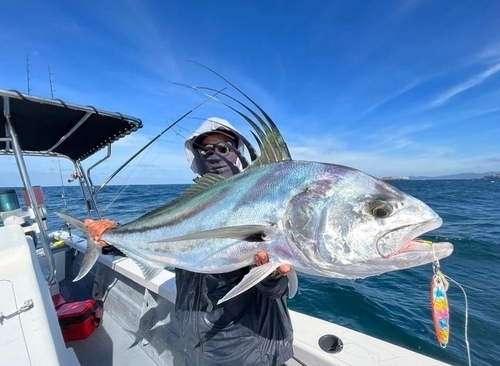
Morphological description: Roosterfish have elongated, fusiform body shapes. Simple teeth form wide bands along the inside of their pointed heads. Their dorsal fin always has seven spines and a separate section of 25 soft rays; their anal fin has two spines and 15 soft rays. Their pectoral fins hold 16 very long, curved soft rays, and the caudal fin is deeply forked. The head and body are silvery reflective, with a base color ranging from bluish to gray. Roosterfish have four distinct black bars: one runs between the eyes, another crosses the rear of the head, and two start at the dorsal fin and curve along the body length toward the tail. The spinal ridge has darker coloration, and a large black patch appears on the lower base of the pectoral fins. The dorsal fin spines are yellowish gray, turning black toward their tips. In juvenile roosterfish, the dorsal fin is black, with a white bar across its center, and white, yellow, and black striping toward the top. Juvenile roosterfish have vertical black bands across their bodies, and most of their body is silver.
Range: Roosterfish are native to nearshore flats of the Pacific Ocean. The northern edge of their range reaches the Pacific Ocean and Gulf of California surrounding the Baja Peninsula. They occur along the coast of Central America extending south to Peru in South America, and are also found in the Galapagos archipelago and Malpelo Island.
Life cycle: Few studies have been conducted on the spawning habits of roosterfish. They typically spawn during warmer months, though the timing varies across their range. During the spawning season, roosterfish gather in large groups called spawning congregations. They perform courtship rituals while migrating. Roosterfish are ovuliparous, meaning they use external fertilization, where sperm and eggs are released directly into open water. When eggs hatch, newly emerged fry are transparent, and this life stage is very vulnerable to predation. Juvenile roosterfish live in shallow coastal waters with abundant food and protection from predators. This habitat behavior supports faster growth. Roosterfish reach sexual maturity at 4 or more years of age. Once they reach this age and reach an adequate body size, they join breeding congregations during the breeding season.

