About Nemapogon granella (Linnaeus, 1758)
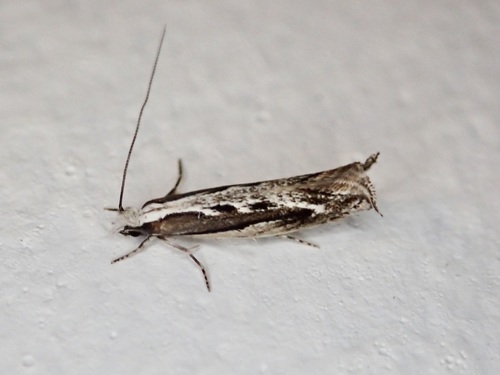
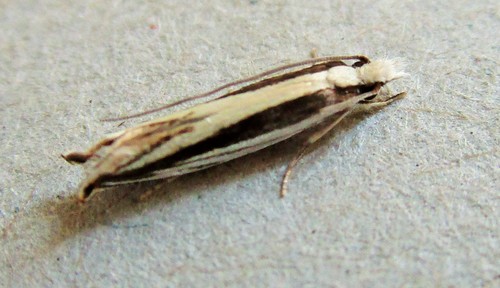
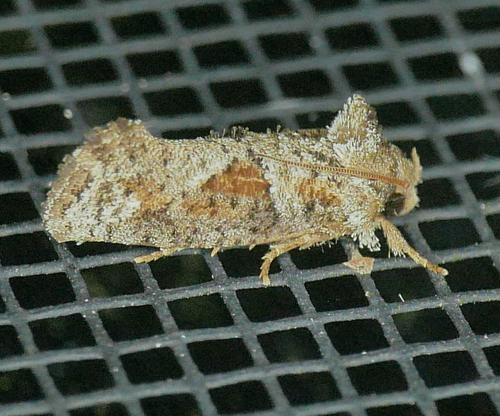
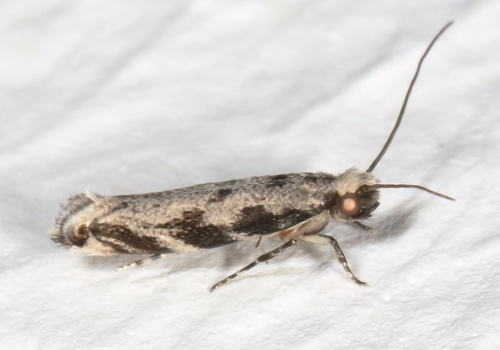
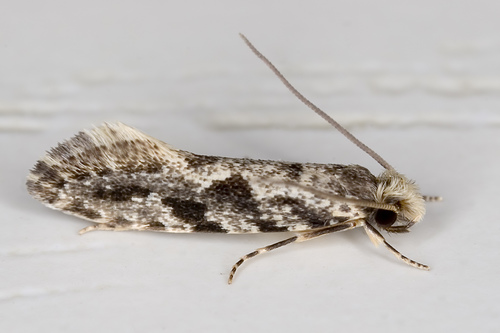
Nemapogon granella (Linnaeus, 1758) is a small moth that is native to the western Palearctic, where it has a broad but patchy distribution. Across its native range, it is widespread in the United Kingdom but may be absent from some local areas. While it has not officially been recorded in France and Slovenia, this absence is most likely due to the species being overlooked or confused with similar closely related species rather than a true lack of populations, as it occurs in neighboring countries. A true absence is more probable for Iceland. As a synanthropic species, this moth has spread to almost every region of the world, though many introduced populations do not persist for long periods. It is, however, regularly found in Australia, which is as distant from its native western Palearctic range as it is possible to be on Earth. Adult moths are most active and commonly seen during summer, which spans from March to September in the United Kingdom. Populations that live alongside humans may be encountered at any time of year. This species has a small wingspan of 10 to 18 millimeters. Its forewings are irregularly mottled in black, white, and grey, an appearance similar to that of its close relative the cork moth (N. cloacella). A row of large black spots runs along the leading edge of the forewing; these spots merge with internal wing spots to form an irregular zigzag band along the length of the wing. The hindwings are a uniform greyish-brown, and are bordered by a fringe of long hairs. Adult moths have a tuft of yellowish-white hairs on the head. In wild populations, caterpillar larvae feed on rotting wood, though they prefer bracket fungi, most commonly from the order Polyporales. Their primary food sources include Polyporaceae species such as sulphur polypore (Laetiporus sulphureus), dryad's saddle (Polyporus squamosus), and turkey tail (Trametes versicolor), plus Fomitopsidaceae such as birch polypore (Piptoporus betulinus). Larvae have also been found feeding on Serpula lacrymans, which belongs to the unrelated order Boletales. Larvae that associate with humans feed on a wide range of dry organic materials: these include dried fruit (such as bilberries in the genus Vaccinium), dried mushrooms, cereal and legume seeds, flour, Topinambur (Helianthus tuberosus) stalks, cork (including wine and champagne bottle corks), and the ergot fungus Claviceps purpurea. There have also been records of larvae feeding on Capsicum annuum fruit, poppyseed (Papaver somniferum), bitter almonds (Prunus amygdalus amara), and beeswax, but it is unclear whether these records refer to Nemapogon granella or to the closely related cork moth.