About Negaprion acutidens (Rüppell, 1837)
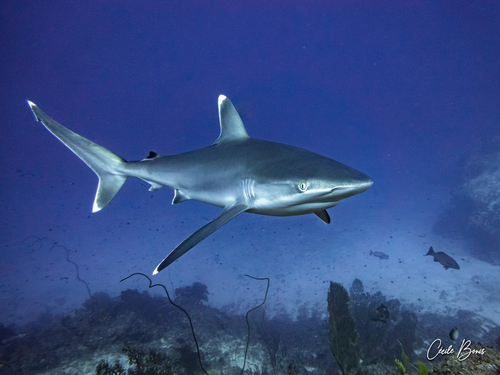
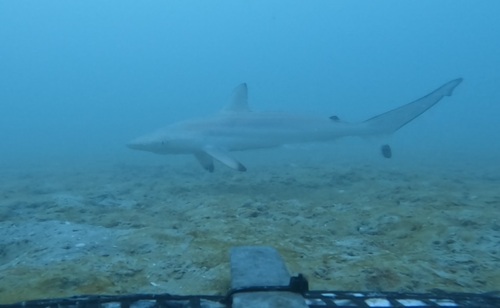
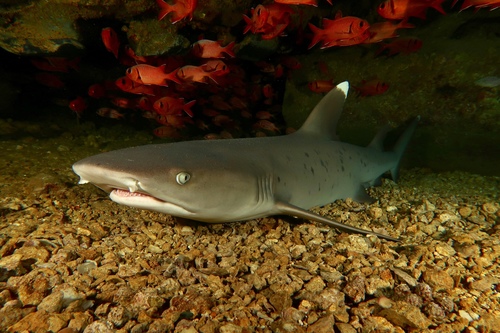
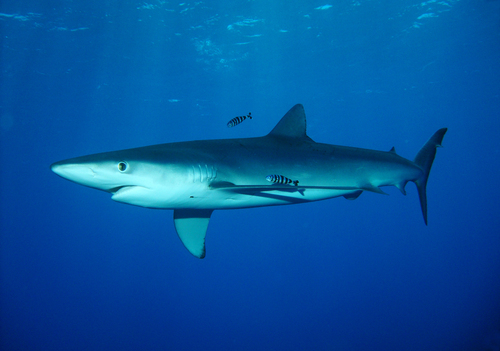
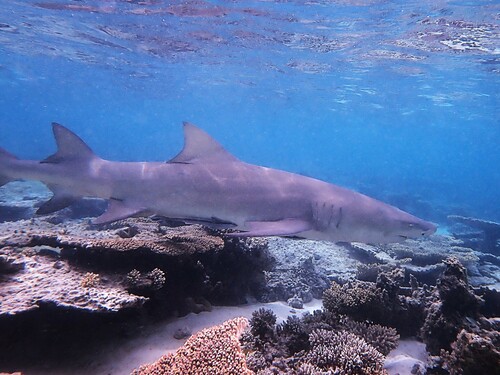
Negaprion acutidens, commonly called the sicklefin lemon shark, has a robust, stocky body with a short, broad head. Its snout is rounded or nearly wedge-shaped, with small nostrils that have triangular flaps of skin in front. It has small eyes and lacks spiracles, and short furrows sit at the corners of its mouth. There are 13 to 16 (most often 14) tooth rows on either side of both jaws, not counting the tiny teeth at the symphysis, or jaw midline. Upper teeth have a large cusp rising from a broad base, with a notch on each side; these teeth grow increasingly angled toward the corners of the mouth. Lower teeth resemble upper teeth but are narrower and more erect. Sharks longer than 1.4 m (4.6 ft) have finely serrated teeth. The fins, especially the dorsal, pectoral, and pelvic fins, are more falcate (sickle-shaped) than those of the closely related American lemon shark. The first dorsal fin sits closer to the pelvic fins than to the pectoral fins. The second dorsal fin is nearly the same size as the first, and is located over or slightly forward of the anal fin. No ridge runs between the two dorsal fins. The pectoral fins are long and broad, and originate below the space between the third and fourth gill slits. The anal fin has a distinct notch along its rear margin. The precaudal pit, a cavity just in front of the caudal fin, is oriented lengthwise. The large, overlapping dermal denticles each bear three to five horizontal ridges. This shark has plain yellowish brown or gray coloration on its upper body, and lighter coloration below, with more yellow visible on its fins. The maximum known length this species can reach is 3.8 m (12 ft), though most individuals do not grow longer than 3.1 m (10 ft). The range of the sicklefin lemon shark stretches from South Africa to the Red Sea, including Mauritius, the Seychelles, and Madagascar, and continues east along the coast of the Indian subcontinent to Southeast Asia. It extends as far north as Taiwan and the Philippines, and as far south as New Guinea and northern Australia. This species is also found around many Pacific islands, including New Caledonia, Palau, the Marshall Islands, the Solomon Islands, Fiji, Vanuatu, and French Polynesia. It likely colonized the central Pacific by infrequently moving between islands. Significant genetic differentiation between populations 7,500 km (4,700 mi) apart in Australia and French Polynesia indicates that there is very little intermixing between regional subpopulations. Sicklefin lemon sharks live on coastal continental and insular shelves, and occur from the intertidal zone down to a depth of 92 m (302 ft). This species prefers still, murky waters, and is most common in bays, estuaries, lagoons, over sandy flats, and on outer reefs. Occasionally, individual sharks will enter open water; one individual was filmed near a sperm whale (Physeter macrocephalus) carcass in the 1971 documentary Blue Water, White Death. Juvenile sicklefin lemon sharks are often found on reef flats or around mangroves, in water shallow enough that their dorsal fins stick out above the surface. In Herald Bight off Western Australia, a known nursery area for this species, juvenile sharks frequent open areas and mangroves in water less than 3 m (9.8 ft) deep, and avoid areas covered by the seagrass Posidonia australis. The sicklefin lemon shark is a sluggish species. It is usually seen cruising slowly just above the seabed or resting still on the bottom, because unlike most requiem sharks, it can actively pump water over its gills. It will move toward the surface when chasing food, and rarely makes long-distance movements. A study of tagged sharks at Aldabra Atoll in the Seychelles found that over 90% of recaptured individuals were still within 2 km (1.2 mi) of their original tagging location. Another study at Moorea in French Polynesia found that some local sharks are year-round residents of the island, while others are more transitory and only visit occasionally. Over 90% of this species' diet is made up of bottom- and shore-dwelling bony fish (teleosts), including herring, mullets, mackerel, silversides, needlefish, smelt-whitings, porgies, sea catfish, triggerfish, parrotfish, and porcupinefish. They will occasionally also eat cephalopods and crustaceans, and older individuals have been recorded consuming stingrays and guitarfish. Larger sharks may prey on the sicklefin lemon shark. Documented parasites of this species include the tapeworms Paraorygmatobothrium arnoldi, Pseudogrillotia spratti, Phoreiobothrium perilocrocodilus, and Platybothrium jondoeorum. Sicklefin lemon sharks have been observed resting on the bottom and being cleaned by bluestreak cleaner wrasses (Labroides dimidiatus); during cleanings, they may open their mouths and stop breathing for up to 150 seconds to give the wrasses access to their mouths and gills. Like other members of its family, the sicklefin lemon shark is viviparous: developing embryos are nourished by a placental connection formed from their used yolk sacs. Females give birth to 1 to 13 pups, most often 6 to 12, every other year in shallow nursery areas, after a 10–11 month gestation period. Unlike the American lemon shark, there is little evidence that this species is philopatric, meaning it returns to its birth site to reproduce. Parturition (birth) happens in October or November at Madagascar and Aldabra, and in January at French Polynesia; ovulation and mating for nonpregnant females occurs around the same time. Embryos develop a placenta after around four months of gestation, when they still retain vestiges of external gills. Newborn pups measure 45–80 cm (18–31 in) in length. Juvenile sharks grow slowly, adding 12.5–15.5 cm (4.9–6.1 in) to their length each year. Both sexes reach sexual maturity when they grow to 2.2–2.4 m (7.2–7.9 ft) long.