About Necturus beyeri Viosca, 1937
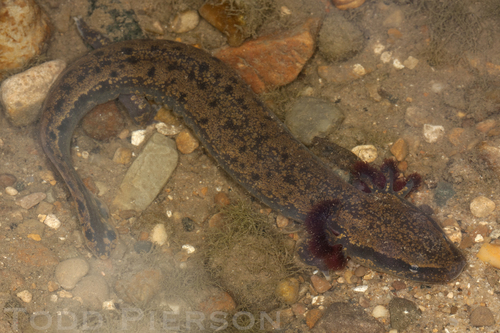
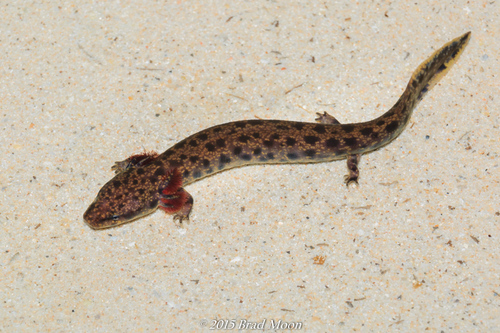
Adults of Necturus beyeri range from 6 to 8.5 inches (15 to 22 cm) in total length. The species is brown, covered in a pattern of light brown and black speckles. Necturus beyeri is neotenic, meaning it retains its external gills and larva-like tail throughout adulthood. It can be told apart from the closely related species N. moleri and N. mounti, which were previously considered to be the same species as N. beyeri, by its consistently larger adult size, heavier dark spotting pattern, and unstriped larvae that have numerous white spots. Necturus beyeri displays sexual dimorphism: males are typically larger than females. This size difference may influence the species' mating behaviors and territorial disputes between individuals. In terms of ecology, Necturus beyeri inhabits streams that have sandy bottoms. Individuals stay either directly on the stream substrate or burrow into it, and sometimes shelter within accumulated aquatic debris. Individuals of both sexes move more frequently during the colder months of the year. They tend to occupy a single site as a home range, and occasionally make long-distance movements away from this home area. Females attach their eggs to submerged aquatic debris.