About Nectarinia famosa (Linnaeus, 1766)
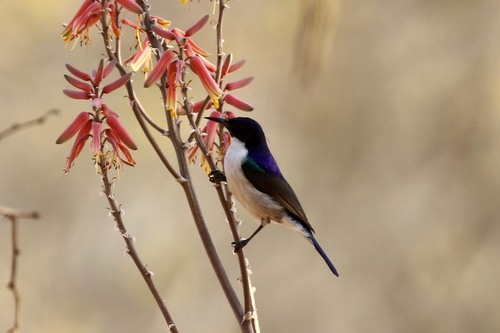
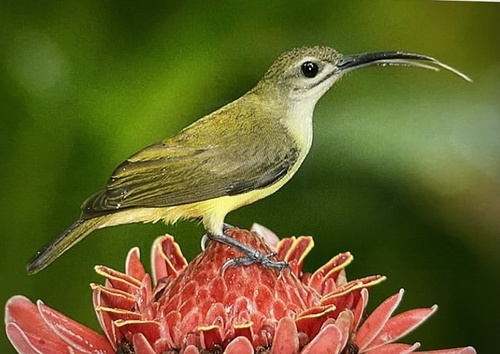
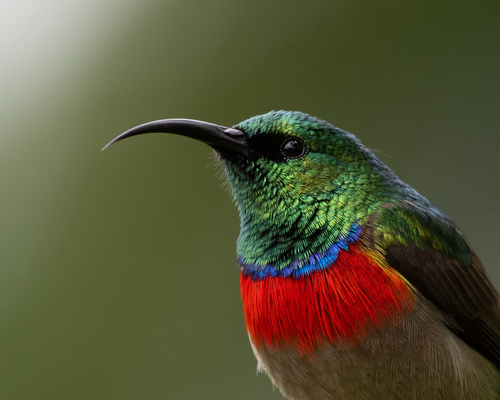
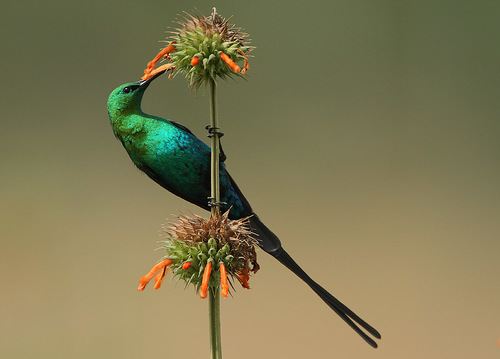
Nectarinia famosa (Linnaeus, 1766), the malachite sunbird, has distinct size and plumage differences between breeding males, non-breeding males, females, and juveniles. The breeding male is marked by very long central tail feathers, reaching a total length of 25 cm, while the shorter-tailed female measures 15 cm long. Breeding adult males have metallic green plumage, with blackish-green wings and small yellow patches on the pectoral area. In non-breeding eclipse plumage, males have brown upperparts, except for their wings and tail which remain green; the non-breeding male still retains its elongated tail feathers. Non-breeding males have yellow underparts flecked with green. Females have brown upperparts, dull yellow underparts with faint indistinct streaking on the breast, and a square-ended tail. Juveniles look identical to females. This large sunbird species inhabits hilly fynbos, including areas with Protea stands and aloes, as well as cool montane and coastal scrub, reaching up to 2,800m in altitude in South Africa. It also lives in parks and gardens, and often nests in Highveld gardens. The species is mostly resident, but individuals may move to lower elevations during the winter. Like most sunbirds, the malachite sunbird feeds mainly on nectar, but will also eat insects, especially when feeding its young. This sunbird can hunt insects in a manner similar to a flycatcher, hawking prey from a perch. While most sunbird species can hover to take nectar like hummingbirds, they usually perch to feed most of the time. The malachite sunbird, which is a fairly large sunbird, follows this same pattern. It has a long thin down-curved bill and a brush-tipped tubular tongue, both traits adapted for feeding on nectar. Specific plant species that malachite sunbirds feed from include many Aloe species such as Aloe broomii, Aloe ferox and Aloe arborescens; Protea species like Protea roupelliae; and various other bird-pollinated plants including Leonotis and Strelitzia. Researchers have suggested that the malachite sunbird’s behavior of guarding flowering plants may have driven the selection and evolution of long-tubed flowers, which would otherwise be at risk of nectar robbing — where short-billed sunbird species take nectar without pollinating the flower.