About Necrobia violacea (Linnaeus, 1758)
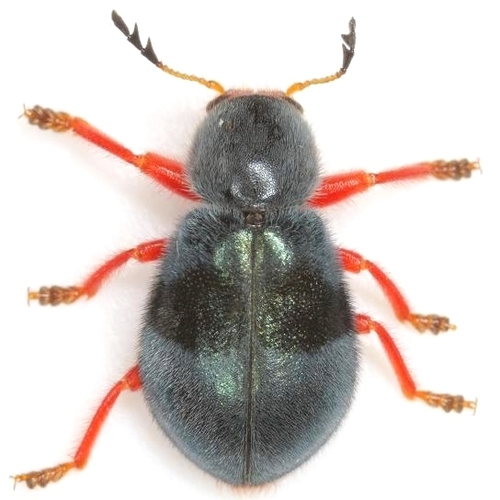
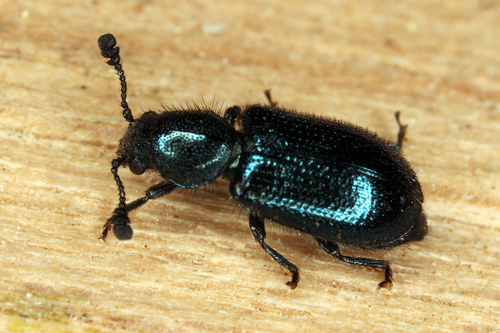
This small beetle reaches four to five millimeters in body length. Its body is roughly 2.5 times longer than it is wide, with a slightly curved overall shape, and an iridescent metallic blue-green to green color covering its entire body including its legs. It has long, protruding hair, including two distinct types of hair, called double hair. The triangular head has bulging eyes and can be retracted slightly into the pronotum. The terminal segment of the jaw palps is spindle-shaped and truncated, unlike the axe-shaped terminal segment found in Korynetes violaceus. It has 11-segmented antennae that are entirely black, ending in a wide, flattened three-lobed club. The final antenna segment is notably larger than the penultimate segment, and the club is more condensed than the antenna club of Korynetes. Unlike the evenly curved pronotum of Korynetes, this species' pronotum widens in a relatively straight line toward the back, making it wider in its last third than the head. The base of the pronotum is curved, ending in pointed posterior angles at the sides; it is edged and coarsely punctured, more coarsely than the pronotum of Korynetes. The elytra are wider at the front than the pronotum, and gradually widen to reach their full width in the last half. The elytra have a generally semicircular shape, with elongated punctures across their surface that become less visible toward the tip. The entire body has two types of hair: pale fine hairs and darker coarse hairs. Darker, longer hairs slant forward, while lighter, shorter, thinner hairs slant backward. The pronotum also has both hair types, though the finer paler hairs are difficult to distinguish among the more prominent darker hairs. Leg hairs range in color from blue to black. The tarsi, the segmented foot sections of the legs, have five joints, but appear to have four because the fourth joint is small and concealed in the cavity of the third joint. The claws at the end of the legs have serrated edges along their base. The genitalia of this species differ greatly from the genitalia of other studied related groups. The phallus and phallobasic apodem are very long, measuring almost twice the length of the tegmen or longer. No visible external differences between males and females of this species are known.