About Necrobia rufipes (Fabricius, 1781)
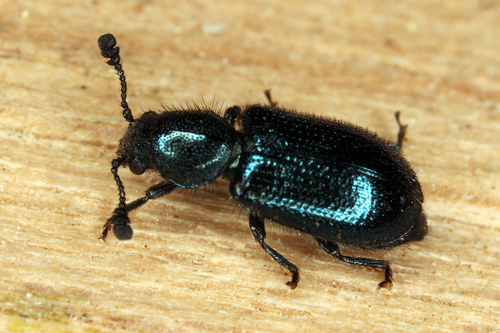
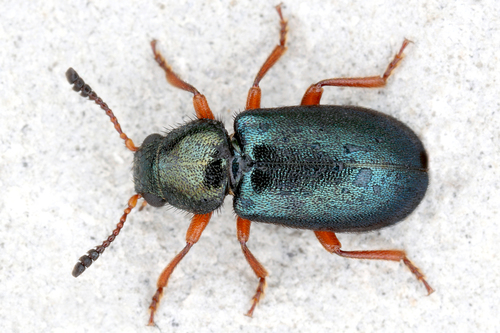
Necrobia rufipes, commonly called the red-legged ham beetle, is a predatory beetle species belonging to the family Cleridae. It has a cosmopolitan distribution, and was first described by Charles De Geer in 1775. Adult red-legged ham beetles are 3.5–7.0 millimetres (0.1–0.3 inches) long, with a convex, straight-sided body shape, and their body surface has indentations called punctures. Their exoskeleton is shiny metallic green or greenish blue, and their legs and antennae are red, with dark club-shaped segments on the antennae. This beetle feeds on the meat-infesting larvae of blow flies (genus Calliphora), Dermestidae beetles, and cheese skippers (family Piophilidae). Adult N. rufipes feed on surfaces, while the larvae bore into dry or smoked meats and cause most of the damage attributed to this species. The red-legged ham beetle also attacks bones, hides, copra, dried egg, cheese, guano, bone meal, dried figs, and palm nut kernels. While the widespread use of refrigeration has reduced this beetle's negative impact on stored meats, it remains a significant destructive pest of dried and salted fish, including herring. This species was already well documented as an agricultural threat by 1925. N. rufipes specimens have been recorded from Egyptian mummies, and the species was once described under the separate name Necrobia mumiarum by Rev. F.W. Hope in 1834. Two closely related species are Necrobia violacea, which has entirely dark legs and antennae, and Necrobia ruficollis, which has light-coloured elytra bases (the shoulder region of the wing covers). While similar in appearance to N. rufipes, neither of these species cause as much damage as N. rufipes. This species should not be confused with its close relative Korynetes caeruleus, another steely-blue beetle in the family Cleridae. Both N. rufipes and K. caeruleus have importance in forensic entomology, though for different reasons.