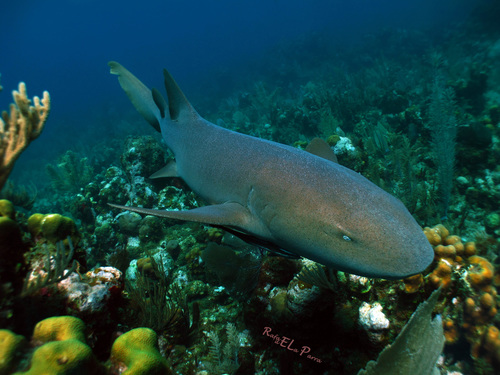
About Nebrius ferrugineus (Lesson, 1831)
The tawny nurse shark (Nebrius ferrugineus) reaches a maximum length of 3.2 m (10 ft). It has a robust, cylindrical body with a broadly rounded, flattened head. Its small eyes face sideways, with prominent ridges above the eyes and smaller spiracles positioned behind them. A pair of long, slender barbels sits in front of its nostrils. The mouth is small, and the lower lip is split into three lobes. There are 29–33 tooth rows in the upper jaw and 26–28 tooth rows in the lower jaw, arranged in an overlapping (imbricate) pattern. A narrow gap separates the outermost 2–4 functional tooth rows from the rest of the rows. Each tooth is fan-shaped, with a broad base that tapers to a small, sharp central point flanked by 3 or more smaller cusps on each side. As the shark ages, its teeth become relatively taller and thicker. The fourth and fifth pairs of gill slits are positioned much closer together than the other gill slits. The dorsal and pelvic fins have angular shapes; the first dorsal fin is larger than the second. The pectoral fins are narrow, pointed, and sickle-shaped (falcate); this fin shape distinguishes the tawny nurse shark from the similar-looking common nurse shark. The origin of the first dorsal fin lines up roughly with the origin of the pelvic fins, while the origin of the anal fin lines up with, or sits slightly behind, the origin of the second dorsal fin. The caudal fin has a shallow upper lobe and a barely developed lower lobe, and makes up about one quarter of the shark's total adult length. The dermal denticles are diamond-shaped, with 4–5 faint ridges that radiate out from a blunt point. Tawny nurse sharks are yellowish, reddish, or grayish brown on their upper surface and off-white on their underside, and can slowly change their body color to better blend into their surroundings. Young tawny nurse sharks have distinctly white lower eyelids. Many tawny nurse sharks found off the coasts of Japan, Taiwan, and the Ryukyu Islands do not have a second dorsal fin. Researchers have speculated that this physical abnormality develops when pregnant females are exposed to unusually high salinity and/or temperature water, which may be caused by human activity. In 1986, a 2.9 m (9 ft 6 in) long adult male tawny nurse shark with both a missing dorsal fin and partial albinism (displayed as a white body with gray-brown eyes) was captured off Wakayama Prefecture, Japan. This anomalous individual is the largest albino shark documented to date, and it survived for a long time in the wild despite lacking natural camouflage. The tawny nurse shark has a wide distribution across the Indo-Pacific region. In the Indian Ocean, it occurs from KwaZulu-Natal, South Africa north to the Red Sea, Persian Gulf, and India, including the waters around Madagascar, Mauritius, the Chagos Archipelago, the Seychelles, and the Maldives. In the western Pacific, it is found from southern Japan and the coast of China to the Philippines, Southeast Asia, and Indonesia, extending as far south as the northern coast of Australia. In the central Pacific, it has been recorded off New Caledonia, Samoa, Palau, the Marshall Islands, and Tahiti. Fossil teeth belonging to this species have been recovered from the Pirabas Formation in northern Brazil, and date to the Lower Miocene (23–16 million years ago). The presence of these fossils shows that the tawny nurse shark's range once extended into the tropical Atlantic Ocean, before the Isthmus of Panama formed. The tawny nurse shark is an inshore species that lives on continental and insular shelves over sandy flats or seagrass beds, as well as along the outer edges of coral or rocky reefs. It can be found from the surf zone, often in water too shallow to fully cover its body, down to a maximum depth of 70 m (230 ft) on coral reefs; it is most commonly found between depths of 5–30 m (16–98 ft). Young sharks generally occupy shallow lagoon areas, while adults can be found in a variety of habitats. Compared to other nurse sharks, the tawny nurse shark has a more streamlined body, and researchers believe it is less bottom-dwelling and a more active swimmer. The physical traits of its body, head, fins, and teeth are similar to other active reef sharks that share its range, such as the sicklefin lemon shark (Negaprion acutidens). Tawny nurse sharks are primarily nocturnal, though they are reported to be active at all hours off the coast of Madagascar, and they become active during the day when fed in captivity. During the day, groups of two dozen or more tawny nurse sharks rest inside caves and under ledges, often stacked on top of one another. Individual sharks have small home ranges that they return to consistently every day. The tawny nurse shark has few natural predators; attacks on this species have been reported from bull sharks (Carcharhinus leucas) and great hammerheads (Sphyrna mokarran). The related common nurse shark is known to be preyed on by tiger sharks (Galeocerdo cuvier) and lemon sharks (Negaprion brevirostris). Five species of tapeworm in the genus Pedibothrium, which infest the shark's spiral intestine, are known parasites of the tawny nurse shark.