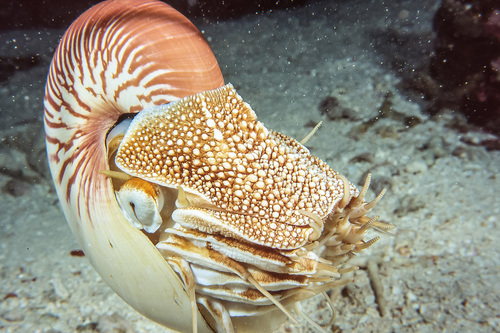
About Nautilus pompilius Linnaeus, 1758
The chambered nautilus (Nautilus pompilius), also known as the pearly nautilus, is the most well-known species of nautilus. When its shell is cut open, it reveals a lining of shiny nacre and forms an almost perfect equiangular spiral, which is not a golden spiral. The shell has countershading: it is light on the lower side and dark on the upper side. This coloration helps it avoid predators, because when viewed from above it blends into the dark sea, and when viewed from below it blends into the light coming from the water’s surface. The chambered nautilus ranges across much of the South Pacific, and has been found near reefs and on the seafloor off the coasts of Australia, Japan, and Micronesia. Like all nautilus species, the chambered nautilus has more primitive eyes than most other cephalopods; its eyes have no lens, so they work like a pinhole camera. This species has around 90 cirri, which are often called tentacles, that do not have suckers. This is a major difference from the limbs of coleoid cephalopods. Like all members of the Nautilus genus, the chambered nautilus has a pair of rhinophores near each eye that detect chemicals, and it uses olfaction and chemotaxis to locate food. The oldest known fossils of this species come from Early Pleistocene sediments off the coast of Luzon in the Philippines. While the chambered nautilus was once considered a living fossil, it is now known to be taxonomically very distinct from ancient ammonites. The recent fossil record for the species shows that modern nautiluses have greater genetic diversity than has been recorded since the extinction of the dinosaurs. In fact, the taxon Nautilus pompilius actually groups dozens of distinct nautilus species under a single name. All nautilus species are threatened by overfishing for their shells, which are mostly used to make jewelry and other ornamental items. In 2016, nautiluses were added to CITES Appendix II, which places restrictions on international trade. Later, the chambered nautilus was listed as a threatened species under the Endangered Species Act. Due to its open ocean habitat, most studies of the chambered nautilus life cycle rely on observations of captive individuals, and its eggs have never been observed in the wild. Though nautiluses have been kept in public aquariums since the 1950s, the chambered nautilus was first successfully bred in captivity at the Waikiki Aquarium in 1995, and a small number of other nautilus species had been bred before this date. Captive breeding of chambered nautiluses remains a rare event today. Unlike most cephalopods, the chambered nautilus has no larval stage. Females lay their eggs in crevices or between corals. The young nautilus’s shell develops inside the egg, and breaks through the top of the egg before the nautilus fully emerges. Depending on water temperature, the eggs hatch after 9 to 15 months. In 2017, chambered nautiluses were bred at Monterey Bay Aquarium, where staff successfully filmed young nautiluses emerging from their eggs. Like other nautiluses, but unlike most other cephalopods, chambered nautiluses are relatively long-lived, and only reach sexual maturity at around 5 years of age.

