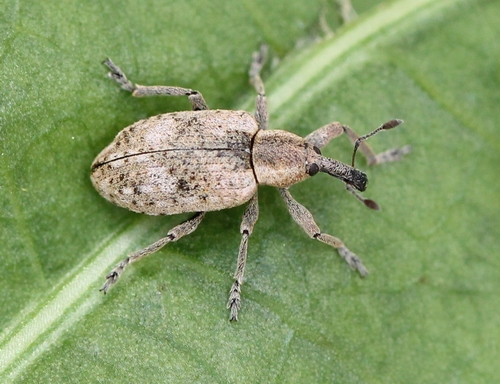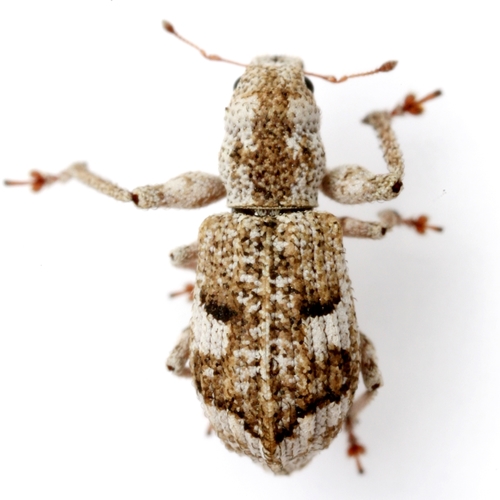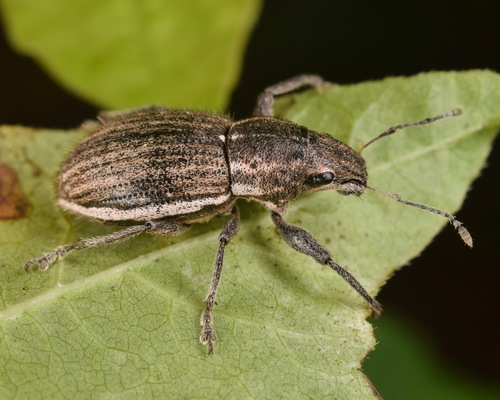
About Naupactus leucoloma Boheman, 1840
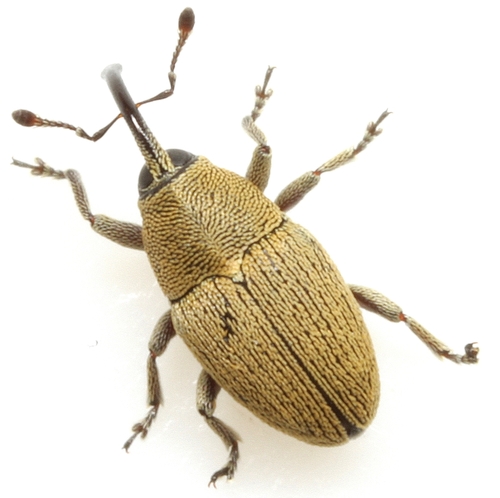
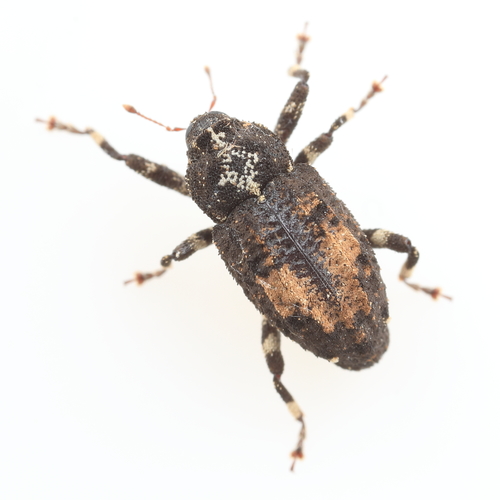
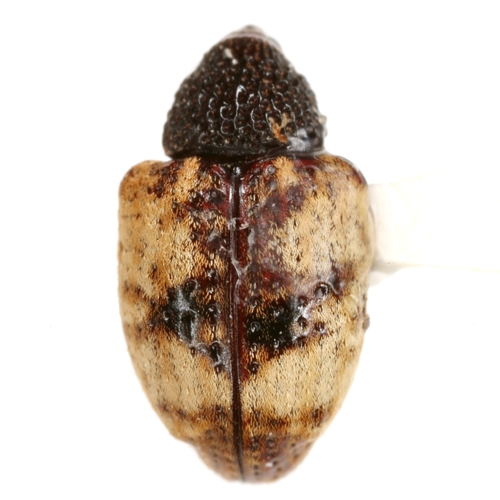
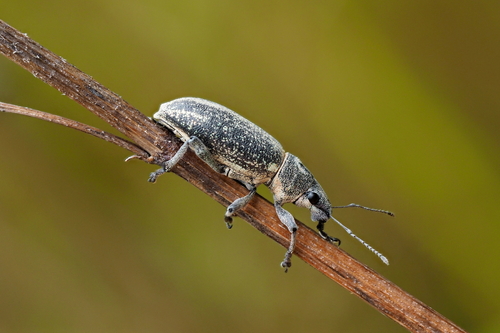
Adult Naupactus leucoloma are dark grey, with two lighter longitudinal bands running down the thorax and head. Adults measure 8 to 12 mm in length and 4 mm wide at the abdomen. The entire body is covered in hairs, which are longer on the forewing. While individual forewings vary greatly in size between specimens, all forewings are fused, which leaves adults unable to fly. Outside the species' native range, no males have ever been recorded, and all individuals in naturalized ranges are female. All reproduction occurs through parthenogenesis. Males are extremely rare, only found within the native South American range, and may already be extinct. Larvae of Naupactus leucoloma grow to around 12 mm long, and live in soil. Like other weevil species, they have no legs. Their heads are partially retracted into the thorax. They are yellowish white in colour, with black mandibles that protrude from the head. Naupactus leucoloma is native to a large portion of Argentina, ranging from the northwestern provinces of Jujay and Salta, all the way southeast to Chubut province. It is also native to Uruguay and southern Brazil. Outside this native range, the species has been introduced through human activity to the United States, South Africa, Chile, Peru, Australia, and New Zealand, where it is now well established. Naupactus leucoloma was first discovered in New Zealand in 1944, and is now widely established across most of the North Island. It has also been recorded in several areas of the South Island, including Nelson, Blenheim, Christchurch, and Ashburton. In its non-native range, Naupactus leucoloma is considered a pest that feeds on 385 different plant species, including beans, clover, and potatoes, among many others. The larval stage feeds on host plant roots, and this feeding causes most of the damage to affected plants. Adult stages feed on leaves, so they are typically found in pastures within non-native ranges. In its native range, the species occupies fertile plains with a temperate climate. Its primary native habitat is grass prairies and grass steppes that have few to no native trees. Because all individuals outside the native range are female, reproduction occurs entirely via parthenogenesis. Eggs are laid in clusters on the ground around cover objects, at the point where the object contacts the soil. If soil is easy to penetrate, eggs are deposited directly into the soil. Clutches usually contain 15 to 25 eggs, though a single clutch can hold as many as 60 eggs. In a study by Young & App, eggs laid between July 21 and August 29 had an average incubation period of 14.7 days. Eggs laid in later months had an average incubation period of 62.4 days, while eggs laid too late in summer overwinter and do not hatch until the following year. The larval stage lasts approximately 10 to 17 months. During this time, larvae go through four or possibly five instar stages before pupating. In New Zealand, larvae first hatch in May, which suggests moist conditions are required for hatching; in North America, hatching occurs in August. Research has found that temperature has a major effect on how long it takes adults to emerge after pupation. Pupae developing in warmer months produce adults in 14 days, while pupae in colder months take up to 30 days for adults to emerge. In New Zealand, adults emerge in December and remain active until April. A single adult Naupactus leucoloma can lay hundreds of eggs during its adult stage. In North America, adults emerge from pupation between May and October, with emergence timing dependent on soil moisture. Adults live and remain active for up to three months.