About Naultinus gemmeus Mccann, 1955
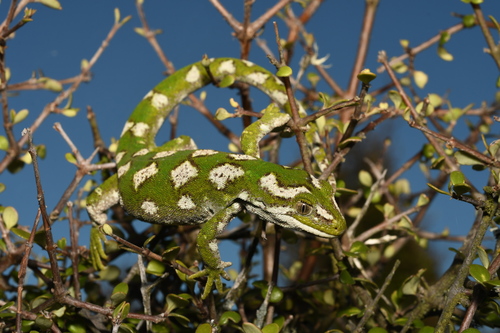
Naultinus gemmeus, commonly known as the jewelled gecko, has a body that ranges from bright to olive green. Its back has either stripes or a diamond pattern, which gives the species its common name and acts as a key identifying feature. The stripes or diamond shapes are most often white, pale green, or yellow, and these markings are typically outlined in black or dark brown. Its underbelly is usually pale greenish yellow or grey, and may sometimes have stripes or streaks as well.
There are visible appearance differences between the Otago and Canterbury subgroups of this species, and between males and females. For both subgroups, females are more likely to have the characteristic jewelled pattern, while males tend to have stripes or no pattern at all. Members of the Otago subgroup typically have a deep blue mouth lining and a blackish tongue, while members of the Canterbury subgroup have a pinkish mouth lining and a pink or orange tongue. Eye colour ranges from brown to olive. This gecko can reach a total length of 18 cm (7.1 in), with a typical snout-to-vent length (SVL, the measurement from snout tip to anus) of 6 to 8 cm (2.4 to 3.1 in). It can weigh up to 15 grams (0.53 oz) and has a very long lifespan of at least 40 years.
The jewelled gecko is native to the South Island of New Zealand, where it is found only in the southeastern portion of the island. Its main populations are located in Canterbury and Otago, with additional smaller populations found in the area between the two regions. These intermediate populations, along with their habitats, are small, isolated, and fragmented. The species has experienced population decline in recent years, and was classified as Near Threatened by the IUCN in 2008.
Its preferred habitats are diverse woody vegetation, drylands, and shrublands. It requires shelter from cold and fire, so it is dependent on woody forest vegetation. The jewelled gecko is an arboreal (tree-dwelling) and diurnal (active during the day) species. It can live in a wide range of tree and shrub species, including mānuka, beech, and tūmatakuru. Rocky outcrops and boulder fields can also provide suitable habitat, as they offer space to escape from predators.