About Naultinus elegans Gray, 1842
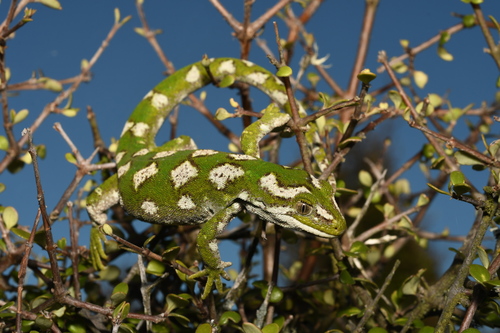
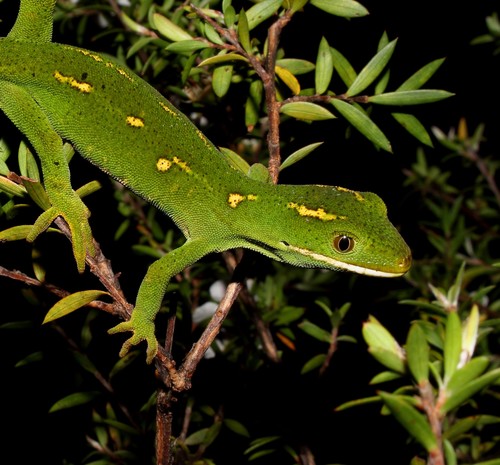
This species, commonly called the Auckland green gecko, was originally formally described by Gray in 1842. Gray's original type description notes that this species has clawed thumbs, with bright green overall colouration that is rather paler on the underside. All of its distinct white markings have narrow black edges: these markings include a streak along the lower lip, markings around the ears, two arched stripes across the top of the head, irregularly shaped spots on each side of the back and hind legs, and an interrupted streak running along each side of the body and tail. There is a crosswise series of 3 larger, compressed scales at the base of the tail. The species can reach a maximum total length of 75 mm (3.0 in), and is easily identified by its bright green colouration. Compared to the closely related Wellington green gecko, the Auckland green gecko Naultinus elegans is marginally smaller, has a more slender build, and has grey-green colouration on the undersides of its feet and toes; Wellington green geckos have yellow colouration on these undersurfaces, and these are the main distinguishing features apart from their differing geographic ranges. This species is distributed across the upper half of New Zealand's North Island, excluding the area north of Whangaroa, and is also found on four islands in the Hauraki Gulf.