About Naucrates ductor (Linnaeus, 1758)
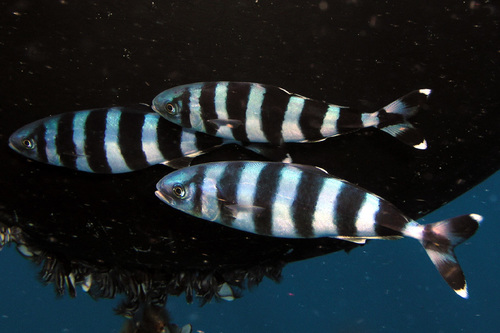
The pilot fish (Naucrates ductor) congregates around sharks, rays, and sea turtles, where it feeds on ectoparasites of its host and leftover food around the host. Younger pilot fish are usually associated with jellyfish and drifting seaweeds. They are also known to follow ships, sometimes over long distances; one individual was found in County Cork, Ireland, and many pilot fish have been sighted on the shores of England. Their tendency to follow ships led ancient people to believe they would navigate a ship to its intended course. Pilot fish base coloration ranges from dark blue to blackish-silver, with a lighter-colored belly. When excited, they show a temporary color change: their dark bars disappear, their body turns silvery-white, and three broad blue patches appear on their back. They can be identified by five to seven distinctive dark transverse bands that are much darker than the rest of their body. Pilot fish can grow to 60–70 cm in length. They are edible and reported to have a good flavor, but are rarely available for consumption due to their erratic behavior when caught. Though pilot fish can be found alongside all types of sharks, they prefer accompanying the oceanic whitetip shark, Carcharhinus longimanus. The relationship between pilot fish and sharks is mutualistic: the pilot fish gains protection from predators, while the shark is freed of parasites. Sailors often said that sharks and pilot fish share something close to close companionship; there are even stories of pilot fish following ships that captured their shark for up to six weeks, and showing signs of distress when the shark was gone. It is rare for a shark to feed on a pilot fish, and smaller pilot fish are regularly observed swimming into sharks' mouths to clean food fragments from between the shark's teeth.