About Natrix helvetica (Lacépède, 1789)
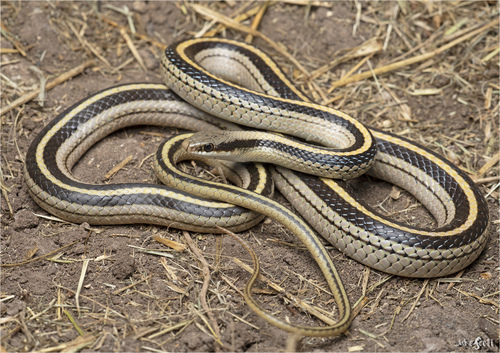
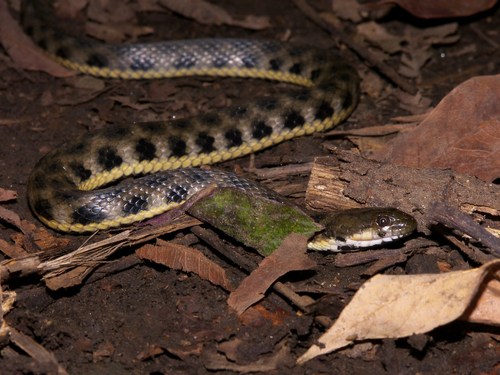
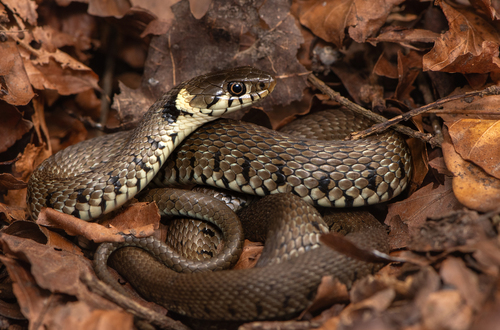
Description: The barred grass snake, Natrix helvetica, has a dark grey-green upper body with distinctive black bar-shaped markings running along its sides. Its underside is pale. Like the common grass snake, it has a distinctive yellow and black collar around its neck. It can grow to over one metre in length. Distribution: This species is found in Great Britain as far north as southern Scotland, and also occurs in the Netherlands, western Germany, Switzerland, Italy and France. The nominate subspecies N. h. helvetica has the widest distribution, ranging from Britain to the Pyrenees and the Rhine region. Habitat: Barred grass snakes are strong swimmers and are most often found near freshwater. However, evidence shows individual snakes do not always need access to bodies of water for the entire active season. Their preferred habitat is open woodland and edge habitats, such as the boundaries between fields and woodlands. These areas provide adequate shelter, while also offering plenty of opportunities for thermoregulation through basking. Pond edges are also favoured sites; the relatively high chance of spotting this elusive species in these areas may explain why it is commonly associated with ponds and water. Barred grass snakes also live in gardens and parks within their native range, as well as in dry grasslands. Like most reptiles, barred grass snakes depend on their thermal environment and need to overwinter in areas that do not freeze. They typically spend the winter underground, where temperatures remain relatively stable. Reproduction: As spring approaches, males emerge from overwintering first, and spend most of the day basking to raise their body temperature and boost their metabolism. This is likely a tactic to maximize sperm production, as males mate with females immediately after females emerge. Females emerge up to two weeks after males, in April, or earlier if environmental temperatures are warm enough. Females lay clutches of eight to 40 leathery eggs between June and July. Eggs hatch after around 10 weeks. To survive and develop properly before hatching, eggs require a minimum temperature of 21 °C (70 °F), and a preferred temperature of 28 °C (82 °F), along with high humidity. Females prefer to lay eggs in areas of rotting vegetation, such as compost heaps. Hatchlings measure about 18 centimetres (7 inches) long when they emerge, and are immediately independent.