About Natator depressus (Garman, 1880)
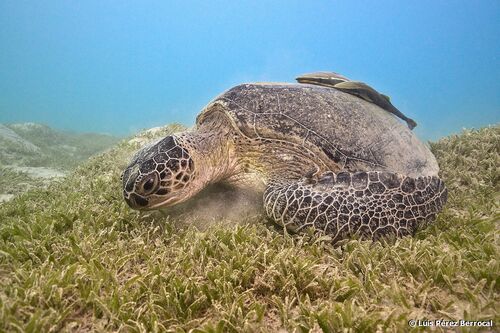
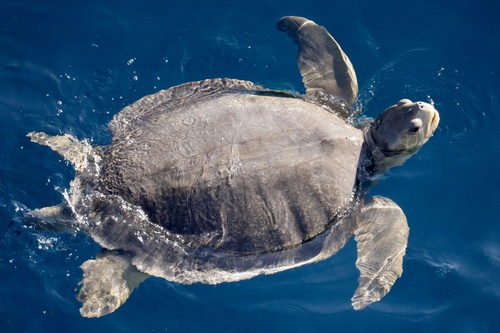
Natator depressus, commonly called the flatback turtle, is a species of sea turtle easily identifiable by its smooth, flat-domed carapace. This shell has non-overlapping scutes, with upturned edges along its sides, and is colored olive green or a mix of grey and green, which matches the color of the turtle’s head. The underside of the shell, called the plastron, is much lighter, with a pale yellow color. On average, adult flatback sea turtles have a carapace length between 76 and 96 cm (30 to 38 in) and weigh 70 to 90 kg (150 to 200 lb); very large recorded specimens can reach up to 350 kg (770 lb). Adult females of this species are larger than males, and consistently have shorter tails than mature males. Additional key identifying features include a single pair of prefrontal scales on the head, and four pairs of costal scutes on the carapace. A unique trait of this sea turtle is that its carapace is much thinner than the shells of other sea turtle species, so it cracks under relatively small pressure. The flatback turtle’s skull looks superficially similar to that of the olive ridley, but the internal structure of its braincase most closely matches that of the green sea turtle. Among the seven living sea turtle species, the flatback sea turtle has the smallest geographic range. It inhabits tropical continental shelf and coastal waters, and unlike other sea turtles, it does not undertake long-distance open-ocean migrations. It typically lives in waters 60 m (200 ft) deep or shallower, and does not have a global distribution like other sea turtles. Its confirmed range includes the coastal waters of Northern Australia, the Tropic of Capricorn, and coastal areas of Papua New Guinea and Indonesia. Within Australia, it is found along eastern Queensland, Torres Strait, the Gulf of Carpentaria, the Northern Territory, and Western Australia. All known nesting sites for this species are located across Australia, in Queensland, the Northern Territory, and Western Australia, with the highest concentration of nesting sites in Queensland’s Gulf of Carpentaria. In Queensland, nesting sites stretch from Bundaberg in the south to the Torres Strait in the north; main nesting sites in this region include the southern Great Barrier Reef, Wild Duck, and Curtis Island, and the Torres Strait also holds major nesting sites. In the Northern Territory, nesting sites are more widely dispersed across a variety of beach types along the coastline. In Western Australia, important nesting sites are located in the Kimberley Region, at Cape Dommett, and on Lacrosse Island. Flatback sea turtles live in shallow, soft-bottomed tropical and subtropical waters, and stay along Australia’s continental shelf. They can be found in seagrass areas, bays, lagoons, estuaries, and any location with a soft-bottomed sea bed. Females prefer to nest on tropical and subtropical sandy beaches, and avoid beaches that have intertidal coral reef flats offshore. They choose beaches where sand temperature at nest depth falls between 29 to 33 °C (84 to 91 °F); this temperature determines the sex of hatchlings, and darker heat-absorbing sand produces female-biased hatchling ratios. Flatback sea turtles reach sexual maturity between 7 and 50 years of age. Adult females nest every two to three years. Mating takes place at sea, so males never return to shore after they hatch. Females return to the same beach for all subsequent clutches in a single nesting season, and will also return to the same beach in future nesting seasons. The timing of the nesting season depends on location: it runs from October to January in southern Queensland, and lasts year-round in the northern and northwestern Australian territories. On average, females lay around three clutches per nesting season, with 15-day intervals between each nesting event. To build a nest, the female first clears dry surface sand using her front flippers, then digs an egg chamber with her back flippers. After laying her eggs, she covers the nest with her back flippers while tossing additional sand backward with her front flippers. Compared to other sea turtles, flatback sea turtles lay fewer eggs per clutch: they average approximately 50 eggs per clutch, while other sea turtle species may lay 100 to 150 eggs per clutch. Flatback eggs are larger than those of many other sea turtles, measuring around 55 mm (2.2 in) in diameter. Hatchling sex is determined by the temperature of the sand surrounding the egg: temperatures below 29 °C (84 °F) produce male hatchlings, while temperatures above 29 °C produce female hatchlings.