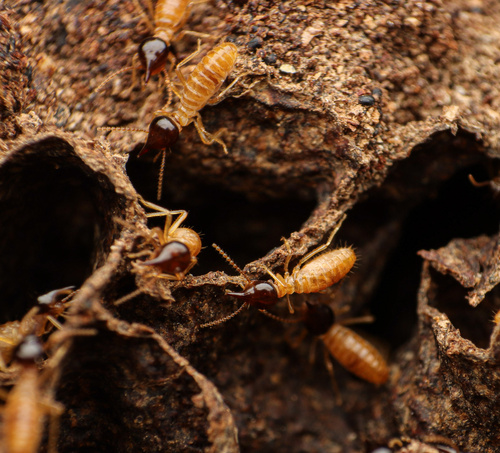
About Nasutitermes corniger (Motschulsky, 1855)
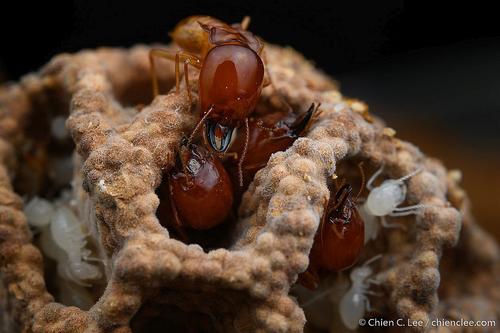
The nests of Nasutitermes corniger have a dark brown surface covered in small external bumps. Small nests, those less than 20 cm in diameter, are typically spherical, but become more elliptical as they grow. Localized lobes may also form on the nest surface. The queen resides in a central nest chamber, which is often located near the tree trunk or branch the nest attaches to. This chamber can measure up to 8 cm wide and 1 cm high, and is heavily reinforced. Nest wall thickness decreases moving from the queen's chamber toward the exterior, though nest walls will be reinforced if the nest is attacked by predators. In one study of N. corniger nests, the heaviest recorded nest weighed 28 kilograms and measured 68 cm by 46 cm by 34 cm. Fertile N. corniger individuals have black wings, dark bodies, and ocelli positioned relatively far from the eyes. N. corniger has been recorded in Mexico, Guatemala, Honduras, Costa Rica, Panama, Venezuela, Trinidad, Tobago, Bolivia, Puerto Rico, and more recently in Florida. The number of fertile individuals produced by N. corniger colonies varies widely. Mature colonies with 50,000 to 400,000 infertile workers typically produce between 5,000 and 25,000 alates, and large colonies may not produce any fertile brood in some years. Alate nymphs develop through five instars, and remain within the parent colony for 5 to 8 months before leaving to mate. When mature, alates typically make up 35% of the total colony biomass. More males than females are produced per colony, but because females are 20 to 40% heavier than males, the total energy investment in each sex is similar. Newly formed N. corniger colonies usually have multiple queens and kings that all share the same royal chamber. Slightly older colonies often have multiple queens (up to 33) but only one king, making the species polygynous at this stage. Over several years, colonies shift to a monogamous structure with only one queen and one king. Early polygyny is advantageous for N. corniger, as it allows the colony to produce many workers in a short time, and produces female alates more quickly than colonies that are monogamous from their founding.