About Nasua olivacea Gray, 1865
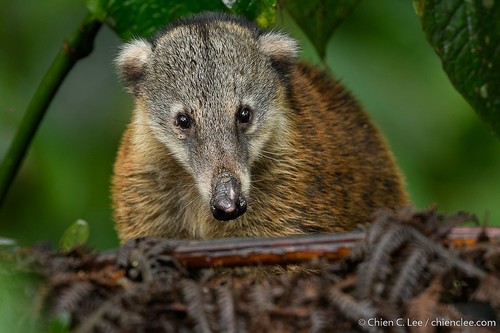
The western mountain coati, also called the western dwarf coati (scientific name Nasuella olivacea), is a small procyonid. It lives in cloud forests and páramo at altitudes between 1,300 and 4,250 metres (4,270 and 13,940 ft) in the Andes of Colombia and Ecuador. A population found in the Apurímac–Cuzco region of southern Peru, over 1,000 km or 620 mi south of the species’ previously known distribution limit, has tentatively been identified as the western mountain coati, but it may instead be an undescribed taxon. Until 2009, the western mountain coati was simply called the mountain coati, and it usually included the eastern mountain coati as a subspecies. The eastern mountain coati is overall smaller, has an average somewhat shorter tail, markedly smaller teeth, and paler olive-brown fur. It also typically has a dark mid-dorsal stripe on its back. By contrast, the western mountain coati is more rufescent or blackish, and usually does not have a dark mid-dorsal stripe. When the two species were grouped together, they were classified as Data Deficient by the IUCN. After the split into separate species, the western mountain coati is classified as Near Threatened. Following a 2020 genetic analysis, the American Society of Mammalogists currently considers N. meridensis a synonym of N. olivacea. There are two recognized subspecies of the western mountain coati: N. o. olivacea and N. o. quitensis. N. o. quitensis is slightly smaller and darker than the nominate subspecies, and it has less distinct rings on its tail. N. o. olivacea is found in Colombia, while N. o. quitensis is found in Ecuador, but the exact boundary between the two subspecies’ distributions is not known.