About Nasua narica (Linnaeus, 1766)
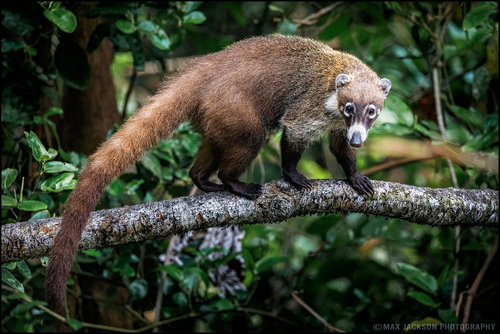
The white-nosed coati, with the scientific name Nasua narica (Linnaeus, 1766), is a coati species and a member of the Procyonidae family, which includes raccoons and their relatives. Region-dependent local Spanish names for this species are antoon, gato solo, pizote, and tejón. Its typical weight ranges from 4–6 kg (8.8–13.2 lb), and its total nose-to-tail length is around 110 cm (3.6 ft), with half of this length made up by the tail. Small females can weigh as little as 3.1 kg (6.8 lb), while large males can reach up to 9 kg (20 lb). The white-nosed coati’s natural distribution extends from as far north as Flagstaff, Arizona and New Mexico, through Mexico and Central America, to the far northwestern region of Colombia near the Panama border. It lives in wooded areas within tropical and subtropical dry broadleaf forests, as well as tropical and subtropical moist broadleaf forests, at elevations from sea level up to 3,000 m (9,800 ft). Coatis from Cozumel Island were once classified as a separate species called the Cozumel Island coati, but the vast majority of recent authorities recognize them as a subspecies of the white-nosed coati, N. narica nelsoni. They are smaller than the adjacent mainland subspecies N. n. yucatanica, but this size difference is less clear when compared to white-nosed coatis more broadly. Other observed differences also support their classification as a subspecies rather than a separate species. White-nosed coatis have been introduced to Florida, and the exact timing of their introduction is unknown. An early "escaped captive" specimen held by the Florida Museum of Natural History dates to 1928. Multiple later cases of coatis escaping captivity have been documented, and there have been numerous sightings since the 1970s, with several live and dead specimens of varying ages recovered. These reports come from a wide area of southern Florida, and there is probable evidence of local breeding, indicating the introduced population is well established. Rare confirmed records of white-nosed coatis exist in Texas, with observations in Cameron County dating back to 1877. Additional sightings were recorded in Maverick County in 1938, Brewster County in 1939, and Uvalde County in 1943. Sightings have also occurred in Aransas County, Kerr County, and three sightings were documented in the Big Bend area between 1959 and 1966. A possible escaped pet was found as road-kill near Abilene in 1975. The two most recent reported Texas sightings were on 27 July 1994 near the Guadalupe River, and on 29 April 1995, when a coati was seen crossing State Road 175 2 miles (3.2 km) north of the intersection of Texas State Highway 77 and State Road 175. Unlike many other Procyonidae relatives such as raccoons and kinkajous, coatis are diurnal, meaning they carry out most of their foraging during the day. White-nosed coatis are documented pollinators of the balsa tree, based on a study of a white-nosed coati population in Costa Rica. Coatis were observed inserting their noses into balsa tree flowers to eat nectar, and the flowers showed no damage after this interaction. Pollen from the flowers covers the coati’s face after feeding, and is dispersed through the surrounding forest when pollen detaches from their fur. Researchers have observed a mutual dependent relationship: the balsa tree provides critical hydration and nutrition to white-nosed coatis when other environmental resources are scarce, and the coati helps the balsa tree increase its population through pollination. Adult male coatis are solitary except during mating season. Females live in social groups called bands, alongside their offspring including males younger than two years old. Gestation lasts 10 to 11 weeks, and litters produce between two and seven young. The young are weaned at four months old and reach adult size at 15 months. In the wild, coatis can live up to seven years. In captivity, the average lifespan of a white-nosed coati is around 14 years, and some individuals kept in human care have lived into their late teens.