About Nassarius pullus (Linnaeus, 1758)
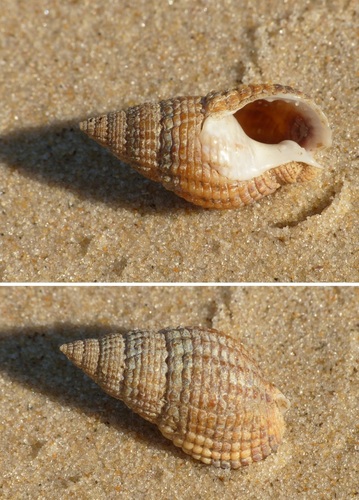
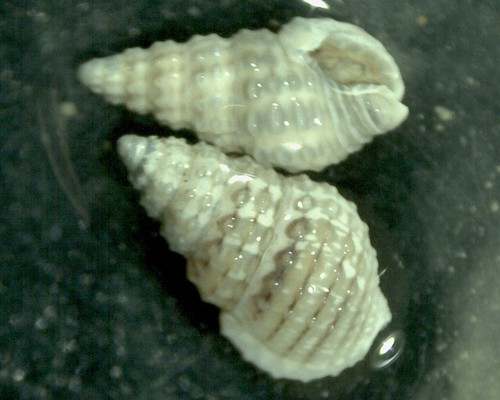
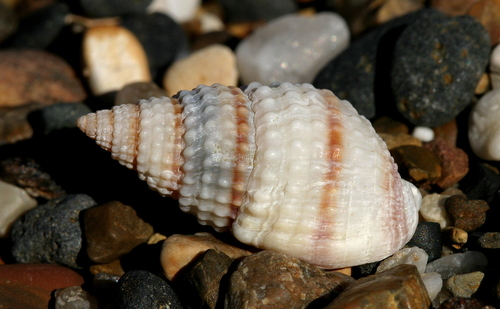
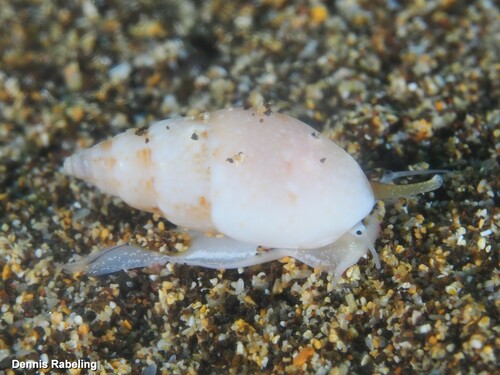
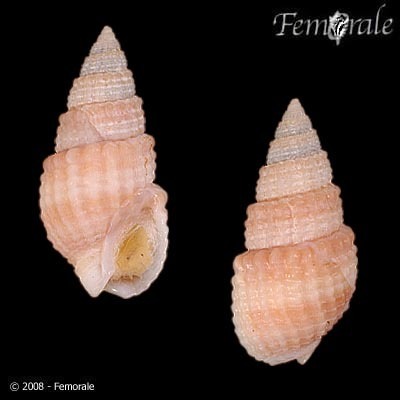
Nassarius pullus (Linnaeus, 1758) has a shell that measures between 10 mm and 25 mm in length. The shell shape is ovate and ventricose, with a pointed spire made up of six or seven whorls. The whorls are slightly angular along their upper portion, and bear very convex longitudinal folds that are most prominent near the suture. These folds are less prominent and more flattened along the outer lip of the body whorl. The entire shell is crossed by numerous transverse striae. A stria sometimes runs along the upper edge of each fold, creating a superficial division between adjacent folds. The aperture of the shell is ovate and white; it is topped by an emargination on the outer lip and a transverse ridge on the inner lip. The outer lip is thin, slightly denticulated at its base, and marked with numerous striae along its inner surface. The columella is curved, and covered by the inner lip, which expands to conceal part of the main body of the shell and forms a large, smooth, white callosity. The base color of the shell ranges from whitish to ash-colored or bluish. Some individuals have no spots or bands, while others have two or three darker bands that encircle the whorls. This species is found in the Central and East Indian Ocean, occurring off the coasts of Mauritius, Madagascar, Tanzania, East India, Sri Lanka, Thailand, the Philippines, and China. It is also found in the Western Pacific Ocean, off Papua New Guinea, New Caledonia, the New Hebrides, the Solomon Islands, and the Australian state of Queensland.