About Naso vlamingii (Valenciennes, 1835)
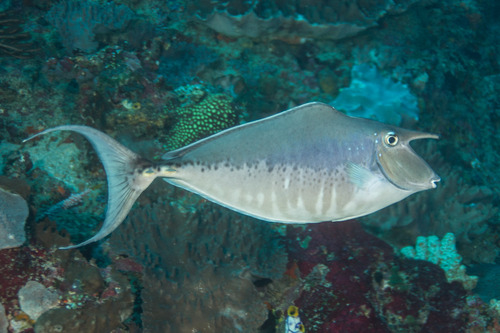
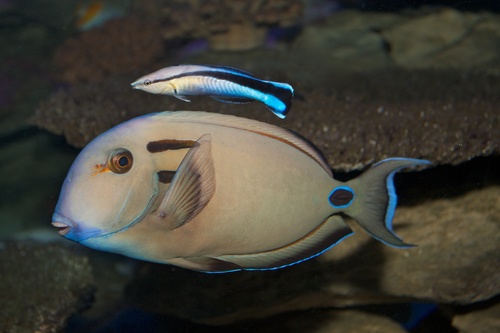
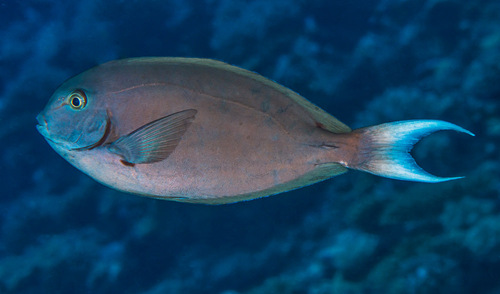
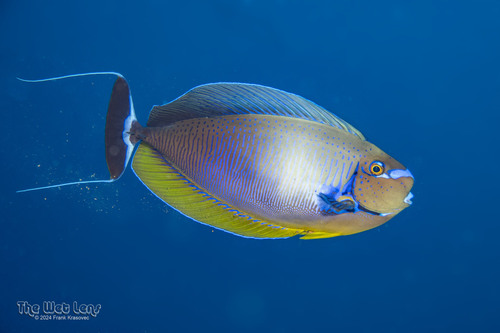
Naso vlamingii has a tall dorsal fin supported by 6 spines and 26 or 27 soft rays, all of similar height. Its anal fin is supported by 2 spines and between 27 and 29 soft rays. This fish has a relatively deep body: in subadults, standard length is 2.2 times the body depth, and in adults this ratio reaches 2.6. An obvious bulbous protuberance grows from the head, above the snout. Each side of the caudal peduncle has two bony plates, which bear keels with spines that point anteriorly. Adult fish grow long filaments from the tips of their caudal fin lobes. Adult individuals are overall greyish-brown or reddish brown, and can change colour quickly. They have small dark blue spots on the head and upper flanks; these spots join to form stripes on the lower flanks. A wide blue band runs from the eye to the front of the bulbous protuberance. The lips are blue, and an irregular blue blotch is located behind the base of the pectoral fin. The caudal fin is blue at its base, grey in the middle, with an ill-defined yellow margin, and blue outer edges of the lobes that extend onto the filaments. The blue markings can intensify to a brilliant blue when the fish displays during courtship, or when communicating with cleaner fish at cleaning stations. The maximum published total length for this species is 60 cm (24 in). Naso vlamingii has a wide distribution across the Indo-Pacific. Its range stretches along the eastern coast of Africa from Kenya to South Africa, continuing through Indian Ocean islands to the Andaman Sea, Indonesia and the Pacific Ocean. It is absent from continental southern Asian waters. In the Pacific, the range extends north to southern Japan, east to the Galápagos Islands, and south to New Caledonia and Australia. In Australia, the species occurs at multiple offshore islands and reefs, along the northern Great Barrier Reef, south to waters off Sydney, New South Wales, and in waters around Lord Howe Island in the Tasman Sea. This species, the bignose unicornfish, lives in deep lagoons and on seaward reefs. It frequently forms schools that feed on zooplankton around elevated areas of deep slopes and drop-offs.