About Naso unicornis (Forsskål, 1775)
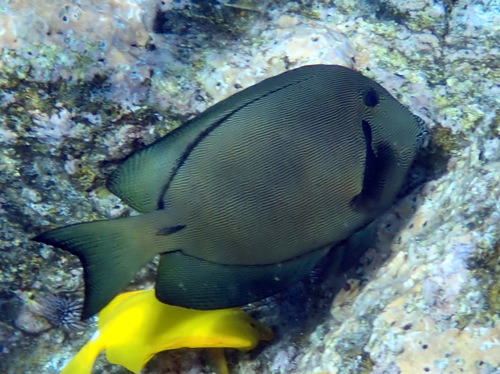
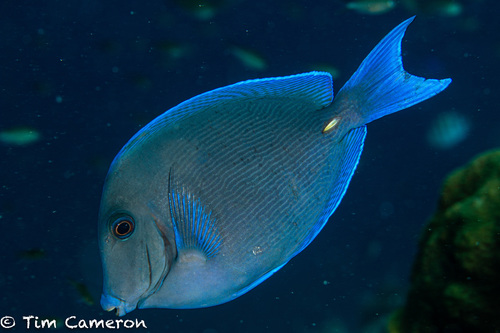
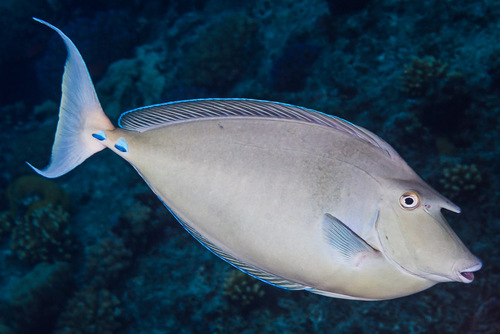
The bluespine unicornfish, scientifically known as Naso unicornis (Forsskål, 1775), has a blueish-gray body. It features two blue spines on each side at the base of the tail, and a short rostrum, also called a bony horn, on its forehead. Small individuals of this species do not yet develop this horn. This species is sexually dimorphic: males have much larger tail spines than females, and on average also have slightly longer horns and slightly longer tail streamers than females. Unlike many fish, this species has leather-like skin instead of scales. Bluespine unicornfish can grow up to 70 cm (28 in), and the heaviest individual ever caught weighed 5.8 kg (13 lb).
The bluespine unicornfish is very common across the tropical Indo-Pacific region, and typically lives in waters with temperatures between 25 and 29 °C (77 and 84 °F). It is a near-shore fish species. Juvenile bluespine unicornfish tend to stay close to the shore, while adults range from shallow waters to the start of deeper areas, staying within the upper 40 feet. They prefer areas with waves or strong surges. They are often found living solitary on coral reefs, but can also gather in small schools of unicornfish, or join larger mixed-species schools with many other fish species.
Because of their high abundance, bluespine unicornfish are eaten in large quantities. They are caught using nets, hook and line fishing, and nighttime spearfishing. Their diet gives them a strong flavor and odor. When skinned, their meat is white with a faint pink-red tinge, and has a firm or moist texture. They are commonly prepared and eaten raw, boiled, grilled, baked, or sauteed. In Hawaii, Naso unicornis and two other Naso species are called kala, and kala was an important food source in pre-colonial Hawaii. The tough skin of kala was sometimes stretched over a half coconut shell to create a small knee drum. Hawaiian people also used kala in ceremonies between members of the same tribe or between different tribes. Today, kala remains a common food source for people in Hawaii and other Pacific Islands.