About Naso tonganus (Valenciennes, 1835)
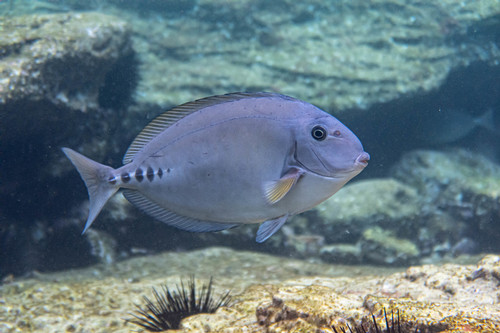
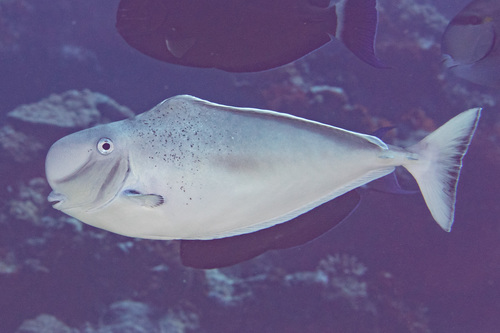
Naso tonganus, first described by Valenciennes in 1835, has a dorsal fin supported by 5 spines and 27 to 30 soft rays, while its anal fin is supported by 2 spines and 26 to 28 soft rays. Each jaw holds between 22 and 46 teeth, a number that increases as the fish grows, and these teeth have serrated tips. The body depth is between 2.3 and 3 times the fish's standard length, and adults have less deep bodies than subadults. Adult fish have a bulging protuberance on the front of the head, which may extend beyond the mouth in larger males. The dorsal profile of the body is distinctly convex below the spiny section of the dorsal fin. There is one pair of bony plates on each side of the caudal peduncle, and each plate bears a forward-projecting point. The caudal fin is emarginate in juveniles and truncate in adults. The overall body coloration ranges from silvery to brownish-grey, fading to yellowish-grey on the ventral portion of the body. An irregular pattern of pale and black spots is present below the spiny part of the dorsal fin. The dorsal fin is dark with a blue margin, and a wide blackish submarginal band runs along the pectoral and caudal fins. Juveniles are covered in dense dark spotting. The maximum published standard length recorded for this species is 60 cm (24 in).
Naso tonganus has a broad distribution across the Indo-Pacific. In the Western Indian Ocean, its range extends along the eastern coast of Africa between Somalia and KwaZulu-Natal, and it is also found in Madagascar, the Comoros, the Seychelles, and the Mascarenes. It occurs around the Maldives, but it appears to be absent from the continental coast of South Asia. Further east, it is found from Thailand eastward to the Samoan Islands, northward to the Ryukyu Islands of southern Japan, and southward to Australia. In Australia, it has been recorded from Shark Bay to North West Cape in Western Australia, as well as at Ashmore Reef, the far northern Great Barrier Reef, and reefs in the Coral Sea extending south to Jervis Bay in New South Wales. It also occurs at Christmas Island and the Cocos (Keeling) Islands.