About Naso lituratus (Forster, 1801)
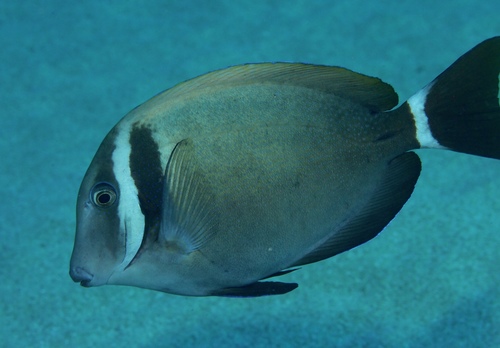
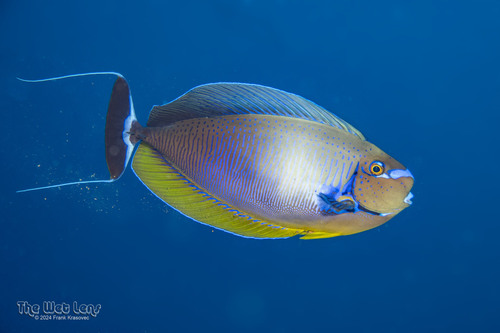
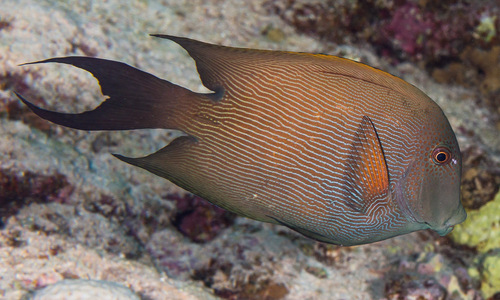
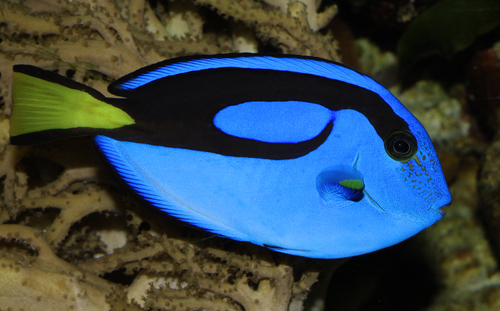
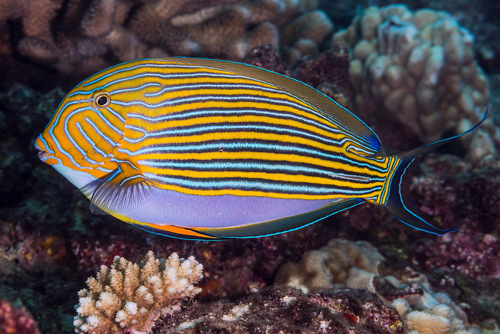
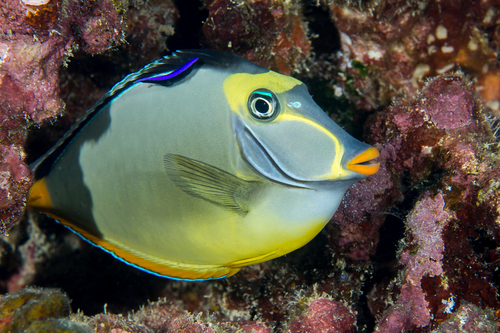
Naso lituratus (Forster, 1801) has distinct identifying features: orange lips, a black face mask, and a caudal peduncle bearing forward-pointing sharp hooked spines. It reaches an adult length of approximately 45 centimeters, with very little additional size growth after reaching this length. It has a single continuous, unnotched dorsal fin positioned on the top of the head, surrounded by a broad black band. The dorsal fin has 6 spines and 27–30 soft rays. It has one long anal fin with 2 spines and 28–30 soft rays. This species has 4 gill rakers on the upper gill limb and 8 to 9 gill rakers on the lower gill limb. It does not have adipose fins. The paired pectoral and pelvic fins each occur in pairs; pectoral fins have 17–18 soft rays and no spines, while pelvic fins have one spine and three soft rays. The caudal fin is lunate, or crescent-shaped. In adult males, the apex of the caudal fin lobe grows a long extended filament. The caudal peduncle holds two sharp, forward-pointing blades. Juveniles have not fully developed caudal blades, and are muted gray-brown with black, yellow, and white patterning. Unlike some other species in the family Acanthuridae, this species does not develop a visible forehead horn or anterior frontal protuberance. This species inhabits coral reefs in the East Indian Ocean and Pacific Ocean, including waters around the Great Barrier Reef, with some populations found in Hawaii. All Acanthuridae, including this species, have separate sexes with clear size differences between the two. In Guam, this species spawns year-round. It requires habitats with high oxygen levels and strong water currents, and lives in groups with other members of its own species. It feeds on wild algae, and uses its sharp caudal spines in self-defense, extending the spines to strike approaching predators.