About Naso brachycentron (Valenciennes, 1835)
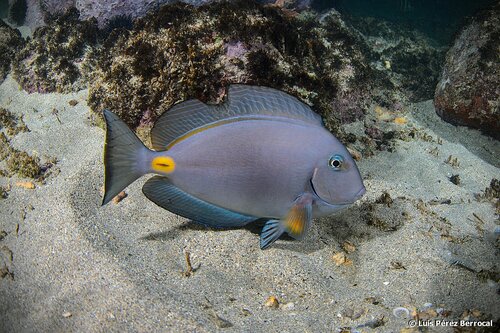
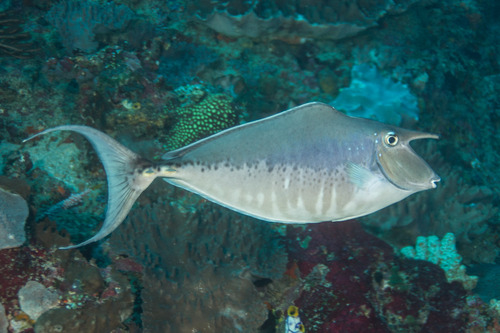
This species has the scientific name Naso brachycentron (Valenciennes, 1835). Its dorsal fin is supported by 4 or 5 spines and between 28 and 30 soft rays, while its anal fin is supported by 2 spines and 27 or 28 soft rays. The body depth of this fish measures between 2.2 and 2.7 times its standard length. For individuals with a standard length greater than approximately 20 cm (7.9 in), a hump begins to develop on the back, creating a concave dorsal profile between the intraorbital area and the soft-rayed portion of the dorsal fin. The snout is steeply sloped. Adult males have a long, tapering bony protuberance in front of the eyes that may extend past the mouth, while this feature is only a small bump in females. Each side of the caudal peduncle has a pair of bony plates with a blade-like keel. The upper body and head are overall grey, and the lower body is paler yellowish or whitish, with an irregular boundary between these differently colored areas. Blue spots are frequently present behind the eyes, and larger males may have dark bars on their lower flanks. This is a relatively large species, with a maximum published fork length of 90 cm (35 in). Naso brachycentron has a wide distribution across the Indian and Pacific Oceans, but it is not found in the Red Sea, the Gulf of Oman or the Persian Gulf. Its range runs along the eastern coast of Africa from Kenya in the north to Sodwana Bay in South Africa, extends through most of the islands of the Indian Ocean east into the Pacific Ocean, reaching east to French Polynesia and the Mariana Islands, north to the Ryukyu Islands, and south to the Great Barrier Reef of Australia. This species occurs as solitary individuals or in small aggregations in shallow reef areas.