About Naso annulatus (Quoy & Gaimard, 1825)
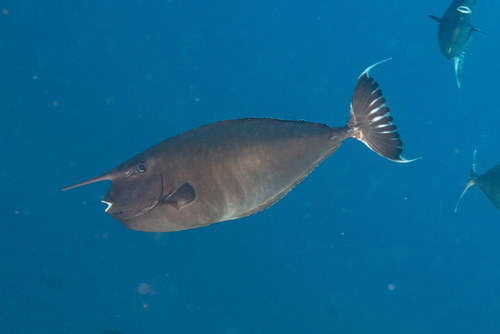
Naso annulatus, commonly called the whitemargin unicornfish, has 5 spines and 28 or 29 soft rays supporting its dorsal fin, while its anal fin contains 2 spines and 27 or 28 soft rays. The standard length of its body is between 2.2 and 3 times its body depth, and the body is deepest in adult individuals. This species has a long, horizontal, tapering bony protuberance in front of its eyes; this structure starts as a small bump in individuals with a total length of less than 20 cm (7.9 in). There is an angle of around 60° between the snout and this protuberance. The caudal peduncle has 2 bony plates on each side, and these plates develop blade-like keels in adults. The caudal fin is truncate in juveniles, becomes scalloped in adults, and males develop long filaments from the tips of the fin lobes. The body’s base color is bluish-grey or bluish-brown, and it is paler on the lower body with no dark markings. This species has white lips. Juveniles and subadults have a distinct white band on the caudal peduncle and a white edge along the caudal fin. As individuals mature into adults, a black submarginal band develops on the caudal fin, while the thin white margin and tail filaments are retained. With a maximum total length of 100 cm (39 in), this is the largest species in the genus Naso, and one of the largest species in the Acanthuridae family. The whitemargin unicornfish has a wide distribution across the Indo-Pacific, ranging from the Red Sea and the eastern coasts of Africa east to Cocos Island, which is part of Costa Rica. Juveniles live in shallow, clear water on reefs in lagoons, at depths as shallow as 1 m (3 ft 3 in). Adults are rarely found at depths of less than 25 m (82 ft), and typically occur off the outer drop-offs of reefs.