About Naria turdus (Lamarck, 1810)
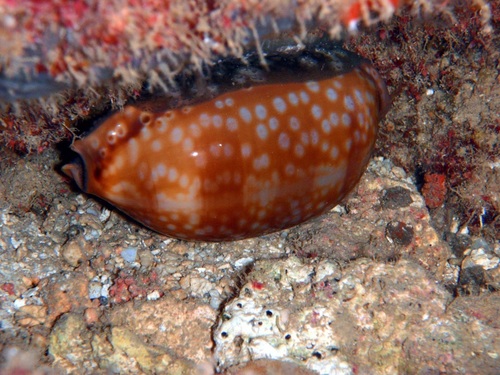
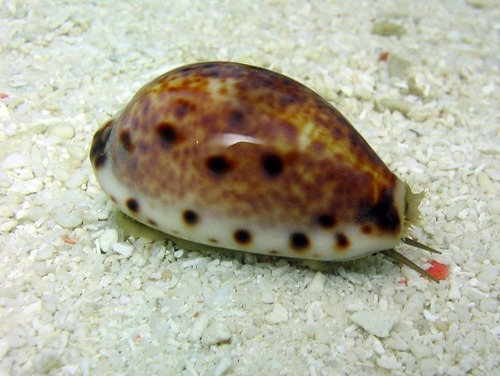
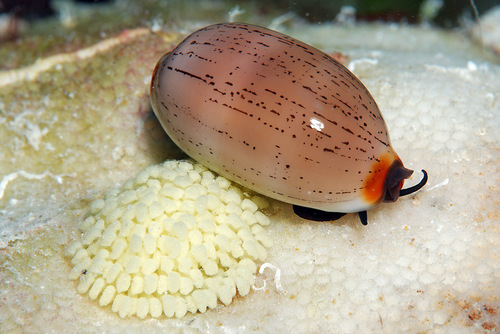
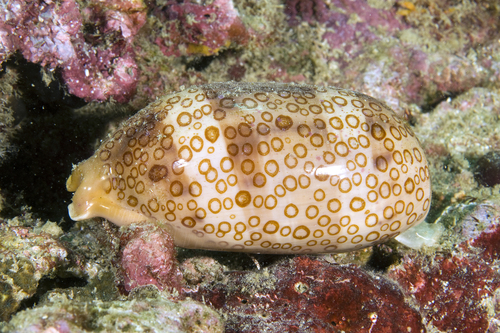
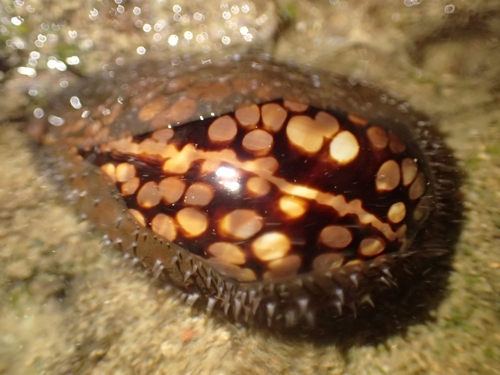
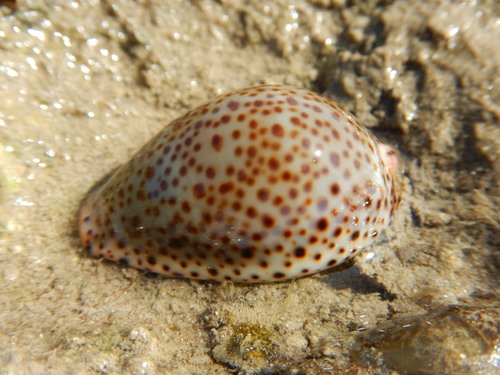
Naria turdus, commonly called the thrush cowry, is a species of cowry. The adult shells of this species average 30–38 millimetres (1.2–1.5 in) in length, with a minimum recorded size of 16 millimetres (0.63 in) and a maximum recorded size of 62 millimetres (2.4 in). Shells of Naria turdus are quite variable in color and pattern. Their overall shape is roughly oval, with a smooth, shiny dorsum surface. The basic shell color is whitish, yellowish, or greenish, covered in small brown spots that grow larger towards the shell's sides. The interior of the shell, which is visible through the aperture, may be light purple. The subspecies Naria turdus dilatata typically has a large, irregular patch on its dorsum. The shell margins are white, marked with several brown dots, and have a pronounced labial callus. The shell base is white or pale pink, sometimes with a small brown mark at its center. The long, wide aperture has approximately 15 teeth on both the columellar and labial sides. Externally, Naria turdus shells are very similar in appearance to the shells of Naria lamarckii. In living individuals, the cowry's mantle is yellowish or beige, covered in long, tree-shaped brown papillae. This species is native to the Red Sea, the Gulf of Oman, and the northwestern Indian Ocean, where it occurs along the coasts of Pakistan and India, and across East Africa including the Comoros, Eritrea, Kenya, Madagascar, Mozambique, Oman, Somalia, Tanzania, and the east coast of South Africa. It is a non-indigenous species that entered European waters and the Mediterranean Sea (including Lampedusa, Israel, Djerba Island in Tunisia, Libya, and Egypt) via introduction through the Suez Canal. Since the early 2020s, this species has also been recorded as an introduced species in the Caribbean, where it has been observed in Aruba, Bonaire, Venezuela, Costa Rica, and Puerto Rico. Naria turdus lives in shallow intertidal waters at depths between 2 and 10 metres (6 ft 7 in – 32 ft 10 in). In the Indian Ocean, it prefers coral reef habitats, while in the Mediterranean Sea it can be found on algal turf, or on sandy and muddy seabeds.