About Nardus stricta L.
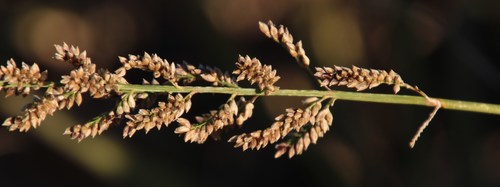
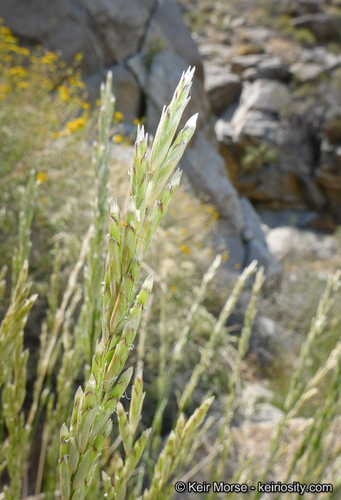
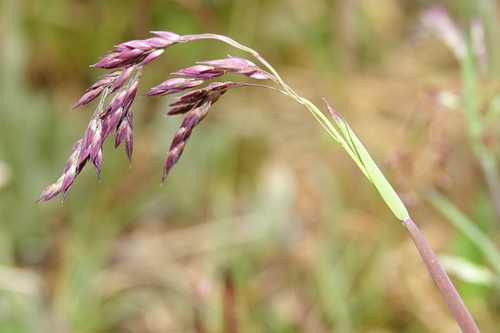
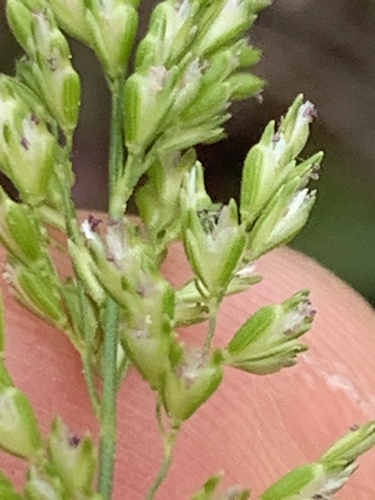
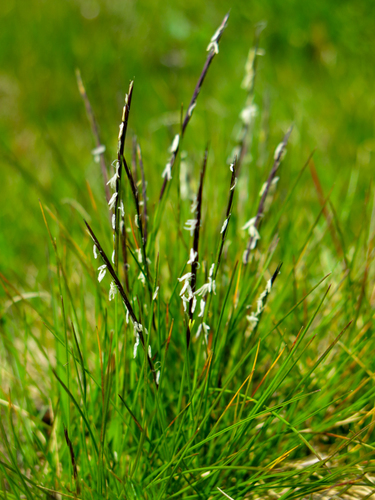
Nardus stricta L. has erect culms that grow 25 to 60 centimetres (10 to 20 inches) long. Its leaf blades are grey-green, filiform and involute, measuring 4 to 30 cm (2 to 10 in) long and 0.5 to 1 millimetre (0.02 to 0.04 in) wide, giving them a bristle-like appearance. The ligules of the plant's basal leaves are 0.4 to 0.8 mm (0.02 to 0.03 in) long and have blunt tips, while ligules on culm leaves are longer, reaching up to 2 mm (0.08 in), and have more pointed tips. At the base of the plant, roots and shoots are very tightly packed together, forming a white, tough, highly reflective structure. The plant's spikelets are very slender and arranged in loosely overlapping rows, with two rows on each side of the spikelet axis. Every lemma has a short awn at its tip. Nardus stricta is native to Eurasia, ranging from Iceland and the Azores to Mongolia; North Africa, where it grows in Algeria and Morocco; and northeastern North America, where it occurs in Greenland, eastern Canada, and the northeastern United States. It grows on heath, moorland, hills, and mountains, preferring nutrient-poor acidic sandy to peaty soils. It is a strongly calcifuge species that does not grow on calcareous soils. It can be found from low elevations up to over 1,000 metres (3,300 ft), and becomes the dominant species in plant communities in late snow patches on mountains. Nardus stricta can also become a dominant species in habitats grazed by cattle or sheep, because it is tough and unpalatable to grazing animals. It flowers between June and August. Apomixis is common in this species, and extensive colonies are often a single clone.