About Narcine bancroftii (Griffith & Smith, 1834)
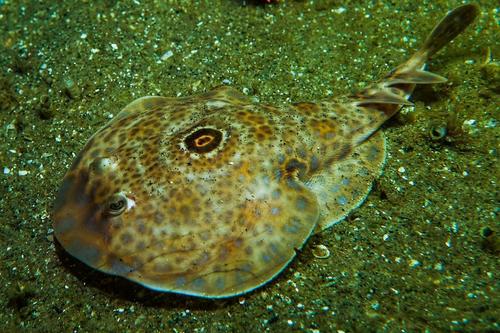
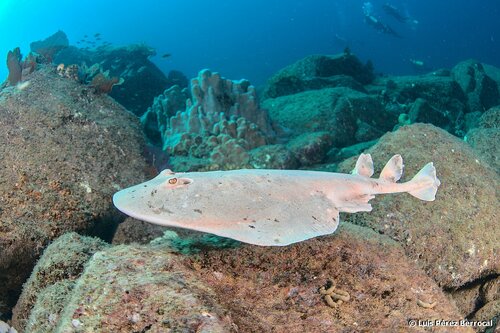
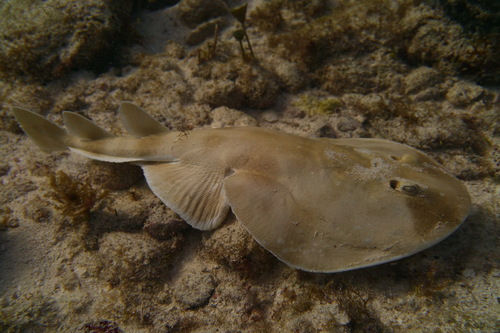
This species of ray, Narcine bancroftii, has a nearly circular body and a short tail. Mature individuals reach approximately 45 centimeters (18 inches) in length and 20 centimeters (8 inches) in width. Its dorsal coloration ranges from dark brown to reddish orange, marked with irregular, sometimes oval-shaped rings. The underside of its body ranges in color from white to greenish. Each jaw holds between 17 and 34 tooth rows, with the number varying based on the size of the individual specimen. Narcine bancroftii has two elongated electric organs that extend from in front of the eyes to the back end of its body disc. These organs can produce a peak voltage of around 14 to 37 volts, which the ray uses to stun prey and defend itself. This species occurs in the Gulf of Mexico, the Caribbean Sea, the West Indies, and the western Atlantic Ocean coastal waters stretching from North Carolina to northeastern Brazil. The lesser electric ray is most commonly found buried under sand or mud in shallow intertidal waters, but it has been recorded at depths of up to 55 meters (180 feet).