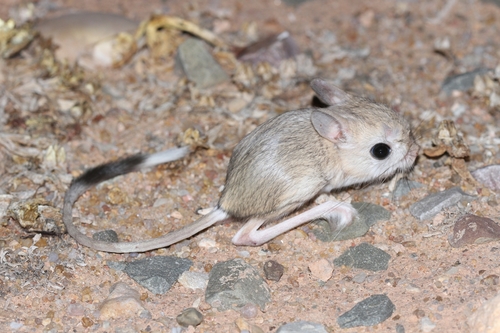
About Napaeozapus insignis (Miller, 1891)
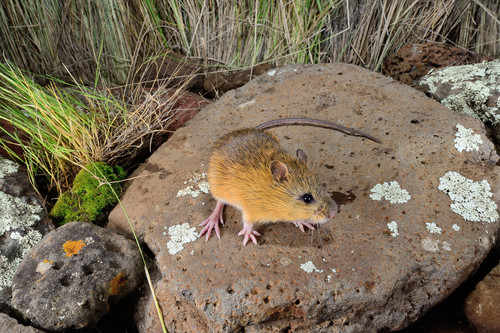
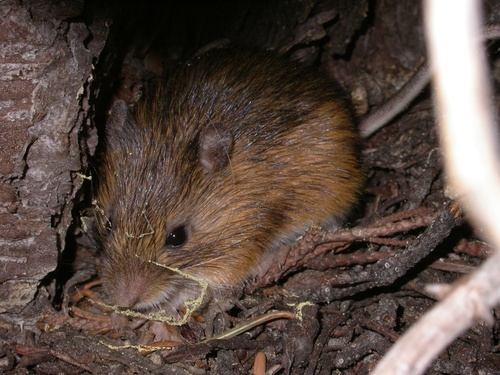
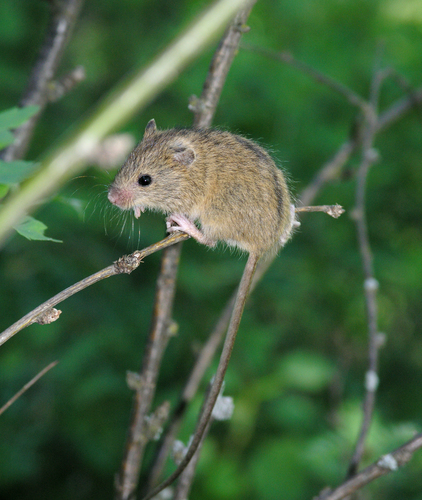
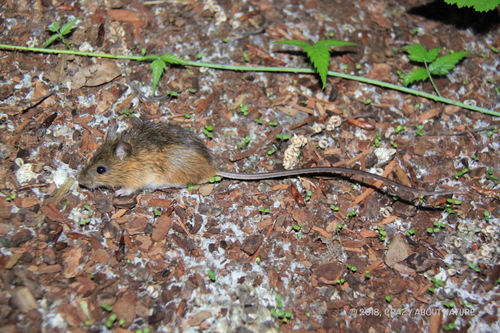
Napaeozapus insignis, commonly called the woodland jumping mouse, is a medium-sized rodent. Individuals of this species are darker in the southern part of their range, and the species has adaptations for living in cold climates. It has a small, high-crowned skull; premolars are absent, three molariform teeth are present, and its grooved incisors are orange or yellow. Its molars are rooted and hypsodont. The tail is dark brown on top, creamy white on the underside, and ends in a white tip; it is sparsely haired, thin, tapered, and scaly, and makes up approximately 60% of the animal’s total body length, a proportion supported by its long vertebrae. Its long bones enable the mouse to leap and jump. The woodland jumping mouse is found across northeastern North America. Its population density is highest in cool, moist boreal woodlands consisting of spruce-fir or hemlock-hardwood, where streams flow from woodlands into meadows and bankside touch-me-nots (Impatiens) grow; it also favors areas where meadow and forest mix, and where water and thick ground cover are available. Mating season runs from May, the start of summer, to August, the end of summer. Gestation lasts around 29 days, resulting in litters of three to six hairless, pink-skinned young. Young woodland jumping mice open their eyes around day 26, are weaned around day 30, and resemble adult individuals by day 34. Females usually produce two or more litters per year, with litter sizes ranging from 1 to 12 juveniles. In observed pairs, the female nurses the young while the male collects food to feed them. Young first leave the nest after 16 days, and leave permanently by 34 days at the latest. Around 90% of all young are eaten, so only one out of every ten young survives to adulthood. Little is understood about wild parental care for this species, because observing individuals in the wild is difficult; additionally, captive females typically commit infanticide shortly after giving birth. Reports of male parental care have not been confirmed, and parental care is primarily provided by the female. Mothers share their nest with their young, and have been observed covering the nest entrance during the day. Young woodland jumping mice have a longer developmental period than most small rodents, so parental care lasts for a longer time than it does in other small rodent species.