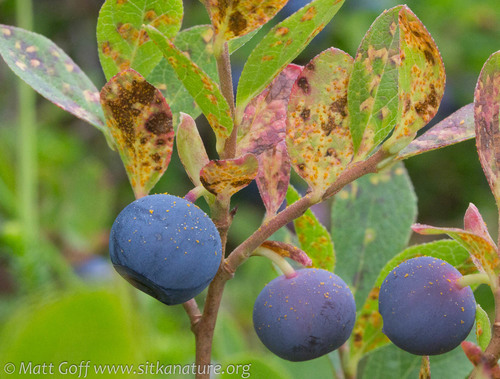
About Naohidemyces vaccinii (Jørst.) S.Sato, Katsuya & Y.Hirats. ex Vanderweyen & Fraiture
Naohidemyces vaccinii is a plant pathogen that infects plants belonging to the Vaccinium and Tsuga genera. It causes leaf rust on lingonberries, blueberries, and cranberries, and early needle cast on hemlocks. This species has been recorded on members of the Vaccinium genus in Canada, the United States (Alaska, Maine, New Hampshire), the United Kingdom, Europe, Russia, China, Korea, and Japan. It has been found on hemlock in Alaska, Idaho, and Washington in the United States, British Columbia in Canada, and Japan. Naohidemyces vaccinii has a wind-dispersed life cycle. In midsummer, it first produces yellow-orange urediniospores in pustules on the underside of Vaccinium leaves. These urediniospores reinfect other Vaccinium leaves and build up the inoculum needed for further reinfection. After this stage, flat crust-like telia develop in late summer to allow the pathogen to overwinter; this stage rarely occurs on lingonberries. In spring, teliospores germinate from the telia, which then form basidia that release basidiospores that travel to Tsuga species. After the basidiospores land on Tsuga needles in spring, pycnia are formed. Finally, in early summer, yellow-orange aeciospores develop inside shallow conical aecia, which grow on the underside of Tsuga needles arranged in two rows along the length of the needle.

