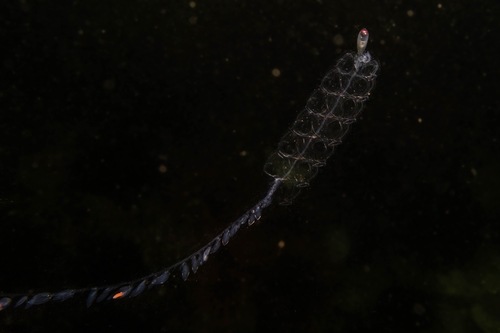
About Nanomia bijuga (Delle Chiaje, 1844)
Nanomia bijuga, like all other siphonophores, is an elongate colonial organism made up of genetically identical, highly specialized zooids. Each zooid carries out a distinct function: prey capture, propulsion, or reproduction, all within a translucent or transparent body that helps the colony camouflage in its oceanic habitat. The colony has two main body segments: an anterior nectosome and a posterior siphosome. The nectosome holds a gas-filled pneumatophore at its end, plus bell-shaped nectophores that help with locomotion. The siphosome holds zooids specialized for feeding, digestion, reproduction, and protection, organized into repeating groups called cormidia. Each cormidium contains one feeding zooid (called a gastrozooid) alongside multiple zooids of other types. Male and female reproductive zooids (gonophores and gonodendrons, respectively) occur together in pairs. Each gastrozooid has its own tentillum, a structure used to capture and subdue prey. Tentilla contain nematocysts (stinging cells that inject toxin into prey), and four distinct types of nematocysts are found in these structures. Heteronemes, the largest nematocysts, have a wider stinging apparatus than the other types, and are mostly found at the proximal end of tentilla. Haplonemes, the most abundant type, are smaller than heteronemes and share a similar structure with open stinging tips, but lack a distinct spiny shaft. The remaining two types, desmonemes and rhopalonemes, both function by adhering to prey to stop it from escaping while stinging cells act. A mature N. bijuga pneumatophore contains five distinct tissues: two layers of ectoderm, two layers of endoderm, and a layer of ectodermal cells that are not connected to any basement membrane. One pair of ectoderm and endoderm layers forms the outside of the pneumatophore, while the second pair sits inside the external layer and forms the gas chamber. Nanomia bijuga is widely distributed across all of the world’s major oceans except the Antarctic Ocean. Confirmed sighted locations include Monterey Bay, the Gulf of Mexico, Sagami Bay (Japan), Hansa Bay (Papua New Guinea), and Bantry Bay (Ireland).

