About Nanger granti (Brooke, 1872)
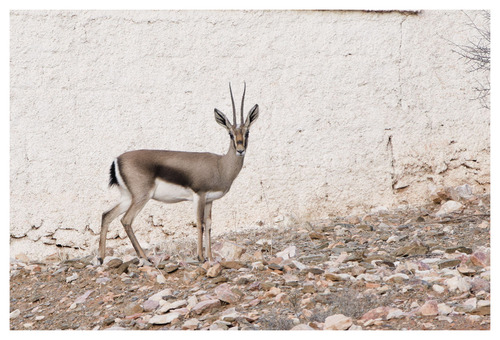
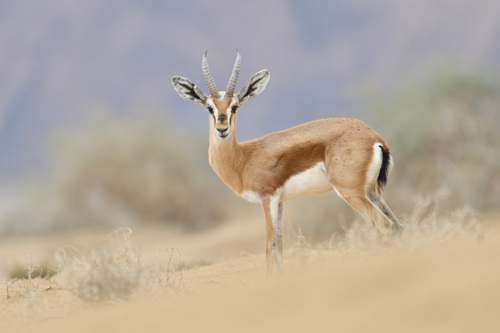
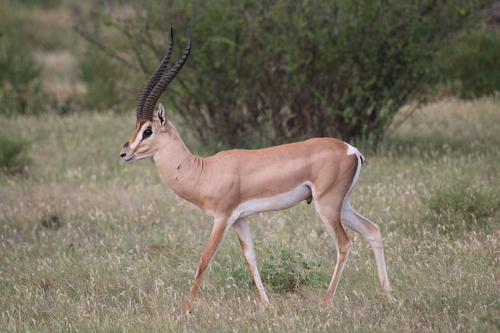
Grant's gazelle (Nanger granti) stands 75–95 cm (30–37 in) at the shoulder. Females weigh 35 to 50 kg (77 to 110 lb), while males weigh 50 to 80 kg (110 to 180 lb). Its back coat is beige orange, and its belly is white. It resembles the smaller Thomson's gazelle, but differs in its larger size and lyre-shaped horns: these horns are stout at the base, clearly ringed, and measure 45–81 cm (18–32 in) long. A key field mark is that the white rump patch of Grant's gazelle extends over the top of the tail, which is not the case for Thomson's gazelle. Subspecies of Grant's gazelle are separated by morphological differences such as horn shape and slight coat color variation, and these differences do not correspond to ecological separation like they do in some other species.
Grant's gazelle is found in multiple East African countries including Ethiopia, Kenya, South Sudan, and Tanzania. It lives in small to midsized herds, typically split into groups of females with juveniles and all-male bachelor groups. During mating season, males become territorial and guard harems of breeding females, so bachelor herds disperse temporarily before tensions calm. Confrontations between hormone-charged territorial males rarely end in violence or death, as the losing individual simply flees.
Grant's gazelle prefers short, grassy plains for grazing, but can also browse and forage in sparse, arid scrublands. It avoids areas with excessively tall grass that reduces visibility of approaching predators. It also lives in semiarid areas, and is well-adapted to drier regions. During dry seasons, it supplements its water intake by eating arboreal browse and shrubby leafy material. It is sometimes seasonally migratory, but does not follow the same routes as most other savanna ungulates including Cape buffalo, plains zebra, Thomson's gazelle, and white-bearded gnu, all of which are far more vulnerable to dehydration. Grant's gazelle can survive on vegetation in waterless, semiarid areas, where it faces much less resource competition.
The most common predators of Grant's gazelle are cheetahs and African wild dogs. Hyenas, leopards, and lions also regularly pose predatory threats. African leopards will hunt Grant's gazelle when given the opportunity, though they tend to prefer impala, an antelope that shares the same open forest-grassland habitat where leopards can wait hidden in trees. African lions could theoretically hunt Grant's gazelle, but their prides generally target larger, more substantial ungulates such as buffalo, gnu, and zebra. Near rivers, streams, and some lakes, Nile crocodiles are a threat to almost any mammal (excluding rhinos, hippos, or elephants) that comes to drink or cross while unaware. Though hippopotamuses are not carnivorous or actively predatory, they are extremely volatile animals with large mouths and teeth. They are known to aggressively chase any other animal that enters their territory, including humans, and this sometimes results in the intruder's death. One YouTube video shows a lost Grant's gazelle attempting to swim across a river holding dozens of hippos, all of which responded with hostility; it is unclear whether the gazelle successfully crossed. Another video shows a Grant's gazelle fleeing a pursuing carnivore by retreating to water, where it was attacked and killed by a hidden submerged hippopotamus. Humans also hunt Grant's gazelle, and its meat is fairly popular in some areas.
In the Serengeti, cheetahs potentially prey on Grant's gazelle, but prefer the smaller Thomson's gazelle. In Nairobi National Park, cheetahs seem to prefer Grant's gazelle over Thomson's gazelle, so the species is an important resource for cheetahs there. Black-backed jackals are major predators of Grant's gazelle fawns.
Grant's gazelle is a gregarious, territorial, and sometimes migratory species. Female home ranges overlap with male home ranges, and only male Grant's gazelles are territorial. Territorial males will herd any females that cross into their territory. When females are in estrus, the dominant male strongly guards them to prevent other males from mating. Any female that tries to leave the territory is aggressively herded back, and most of the time the male's positioning relative to the female is enough to stop her from leaving. Bachelor groups are made up of adolescent males and adult males that do not currently hold territory. Potential new members perform mock-intimidation displays to join the group, but bachelor groups are generally loose and members can enter and leave freely. Grant's gazelle will sometimes join groups of Thomson's gazelle to protect themselves from predators; predators are less likely to attack Grant's gazelle in these mixed groups, possibly because Thomson's gazelle provides an easier target. Larger, older males with thick horns have the highest chance of establishing a territory. Conflicts between adult males are usually resolved through intimidation displays: males circle each other and swing their necks side to side to display neck strength. Neck strength matters in actual fights, so the male that cannot keep up concedes. Males with nearly equal neck strength are more likely to fight. Actual fighting occurs more often in young males than in older ones, and dominant males can simply run off subordinates without needing to display.
Grant's gazelles reach sexual maturity at 18 months old. Territorial males mate more often than males in bachelor groups. The courtship ritual starts when a male follows a female, waiting for her to urinate. When she urinates, the male performs the Flehmen response to check if she is in estrus. If she is in estrus, he continues following her. The female will lift her tail to signal she is ready to mate, and the male will mount her. The gestation period for Grant's gazelle is 198 days. In the Serengeti, births peak in January and February. A pregnant female will leave her herd to find a well-hidden location to give birth. After giving birth, the female eats the afterbirth and other birthing fluids to keep the fawn clean and scentless. Recently postpartum females stay together for protection. Females nurse their fawns four times per day. Fawns are immobile for the first few days, and their mother stays close by. When the fawn can walk, it leaves with its mother to rejoin a herd. Around this time, fawns form peer groups with other young gazelles. Grant's gazelle is weaned at six months old, but will continue to associate with its mother until it reaches adolescence.