About Nanger dama (Pallas, 1766)
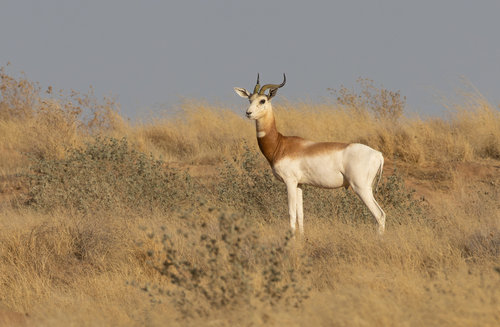
The dama gazelle (Nanger dama) has a white body with a reddish-brown head and neck. Most individuals of both sexes have medium-length, ringed horns that curve in an S-shape; males’ horns measure around 35 cm (14 in) long, while females’ horns are much shorter. This gazelle has a small head with a narrow muzzle, relatively large eyes, a longer neck, and longer legs than most other gazelle species. It stands 90 to 95 cm (35 to 37 in) tall at the shoulder, weighs 35 to 75 kg (77 to 165 lb), and can live up to 12 years in the wild, or up to 18 years in captivity. A few days after birth, young dama gazelles are strong enough to follow the herd, and after one week they can run as fast as adult dama gazelles. The dama gazelle is recognized as the largest gazelle species. Its extremely long legs have extra surface area for heat dissipation, which helps it stay cool in its hot desert habitat. While it generally needs more water than some other desert-dwelling gazelle relatives, it can survive fairly long periods of drought. Unlike many other desert mammals, the dama gazelle is diurnal, meaning it is active during the daytime. The dama gazelle is constantly alert for danger, and uses a behavior called pronking to warn other herd members of threats. During pronking, the animal hops up and down with all four legs kept stiff, so all limbs leave and touch the ground at the same time. Males establish individual territories, and during breeding season they actively block other mature males from entering these areas. They mark their territory boundaries using urine, piles of dung, and secretions from glands located near their eyes.