About Naja siamensis Laurenti, 1768
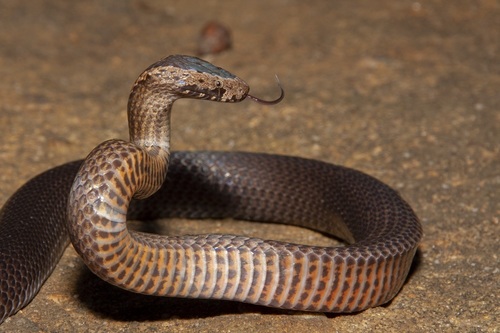
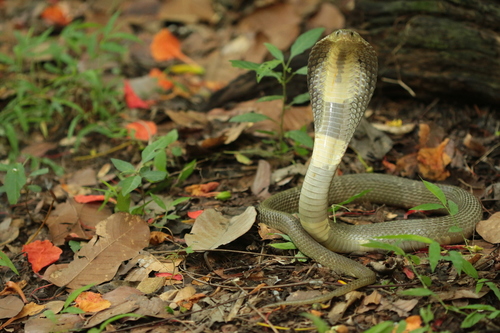
This is a medium-sized elapid that has a more slender build than most other cobras in the genus Naja. Its body colour varies from grey to brown to black, with white spots or stripes. White patterning can be so extensive that it covers most of the snake's body. A highly distinct black and white colour phase is common in central Thailand; specimens from western Thailand are mostly black, while individuals from other areas are usually brown. The hood mark may be spectacle-shaped, irregular, or missing entirely, especially in adults. Adult individuals average between 0.9 to 1.2 metres (3.0 to 3.9 ft) in length, and can rarely reach up to 1.6 metres (5 ft) in length. Adult body mass tends to be around 1,600 grams. This species should not be confused with the monocled cobra (Naja kaouthia), which shares similar habitat, size and appearance. A key distinguishing feature is that this species is a "true spitter" that readily spits venom. Unlike many other spitting cobras that produce a stream of venom, this species typically ejects venom as a mist. The commonly reported spitting range for this species is approximately 1 metre (3.3 ft), the shortest range of any spitting cobra. However, unpublished work by Wüster notes that N. siamensis spits readily and may have a longer spitting range closer to 2 metres (6.6 ft), and that the venom is released as a stream in this case. This species is found in Southeast Asia, including Thailand, Cambodia, Vietnam, and Laos. It may occur in eastern Myanmar, but no confirmed records of its presence there are known. It has been reported in Taiwan, where individuals were released into the wild based on folk Buddhist practices. It occupies a wide range of habitats including lowlands, hills, plains, woodland, and jungle. It is sometimes drawn to human settlements, attracted by the abundant rodent populations living in and around these areas. This snake is oviparous. Females lay 13 to 19 eggs 100 days after oviposition. Eggs hatch after 48 to 70 days, with incubation time depending on incubation temperature. Hatchlings are fully independent immediately after hatching. Most hatchlings measure between 12 to 20 cm long, and some can reach up to 32 cm in length. Because they have fully developed venom delivery systems, hatchlings should be treated with the same caution as adult individuals.