About Naja nivea (Linnaeus, 1758)
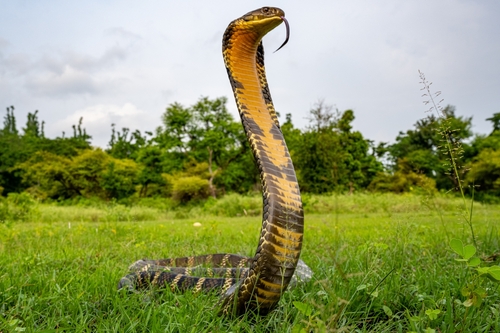
The Cape cobra (scientific name Naja nivea (Linnaeus, 1758)) is a medium-sized cobra species. Mature individuals are typically 1.2 to 1.4 m (3.9 to 4.6 ft) long, and can grow up to 1.6 m (5.2 ft); males are slightly larger than females. The longest recorded specimen is a male from Aus, Namibia that measured 1.88 m (6.2 ft) long; another very large male found at De Hoop Nature Reserve measured 1.86 metres (6.1 ft) in total length. Cape cobras show very wide variation in coloration, ranging from yellow, golden brown, and dark brown to even black. Individuals also have varying degrees of black or pale stippling and blotches. While color and marking patterns are linked to geography, nearly all color varieties can be found within a single location. For example, specimens from the Kalahari Desert in Botswana and Namibia are usually more consistently yellow than populations from further south, but all color variations have been recorded at De Hoop and other specific locations in the Western Cape. Juvenile Cape cobras generally have a noticeably dark throat that extends down the belly across roughly a dozen ventral scales. This dark color fades during the first one to two years of life; while the dark marking is still present, laypeople commonly confuse juvenile Cape cobras with the Rinkhals spitting cobra.
The Cape cobra is endemic to southern Africa. It occurs most commonly in South Africa, where it can be found across the Western Cape, Northern Cape, Eastern Cape, Free State, and North West Province. It is also found in the southern half of Namibia, southwestern Botswana, and western Lesotho. While the Cape cobra has a smaller geographic range than any other African cobra, it occupies a wide variety of habitats. Its preferred habitats are fynbos, bushveld, karoo scrubland, arid savanna, the Namib desert, and the Kalahari desert. It often lives in rodent burrows, abandoned termite mounds, and rock crevices in arid regions. In temperate and arid karroid regions within its range, it is often found along rivers and streams in well-drained open areas. In Lesotho, it can occur at altitudes up to 2,500 m (8,200 ft) above sea level. It can be found in forest and high grassland areas of Free State province, the rocky hills of Cape Province, and desert and semidesert areas throughout its entire distribution.
The Cape cobra is diurnal, and actively forages throughout the day. During extremely hot weather, it may become crepuscular, but is very rarely if ever observed active after dark. It is a terrestrial snake, but readily climbs trees and bushes, and shows high agility when systematically raiding the nests of sociable weavers, for example. When not active, it hides in holes or under ground cover such as brush piles, and often stays in the same retreat for an extended period. It is a quick-moving, alert species. While one report notes that this species is generally calmer than some other African venomous snakes, it will strike readily if threatened. When disturbed and cornered, the Cape cobra lifts its forebody off the ground, spreads a broad hood, and may hiss loudly. It strikes without hesitation when in a defensive posture. If the threat stays motionless, the snake will quickly attempt to escape, but will return to its defensive posture at any sign of movement. Cape cobras are more aggressive during the mating season.
This species is oviparous. Mating takes place in September and October, when cobras are more aggressive than usual. Females lay between 8 and 20 eggs, which measure roughly 60 × 25 mm, in midsummer (December to January). Eggs are laid in a hole, abandoned termite mound, or another warm, moist location. Hatchlings are between 34 and 40 cm (13 and 16 in) long, and are completely independent immediately after birth. In one captive study, mating occurred in September, oviposition in November, and the gestation period lasted roughly 42 days. Incubation lasted 65 to 70 days at a temperature of 28 to 33 °C (82 to 91 °F). For the two clutches observed in the study, clutch size ranged from 11 to 14, and the hatchling sex ratio was one male to five females.