About Naja nigricollis Reinhardt, 1843
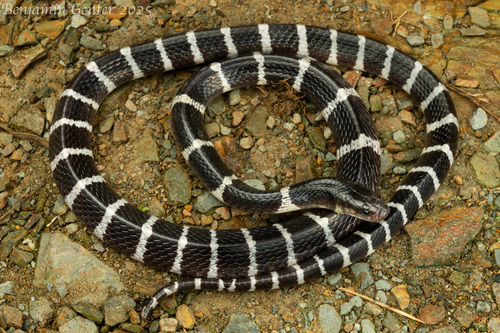
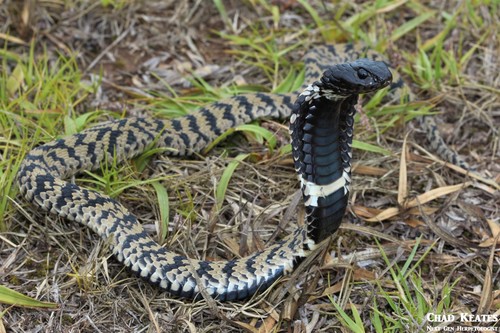
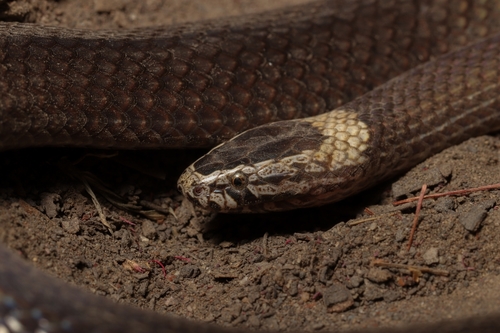
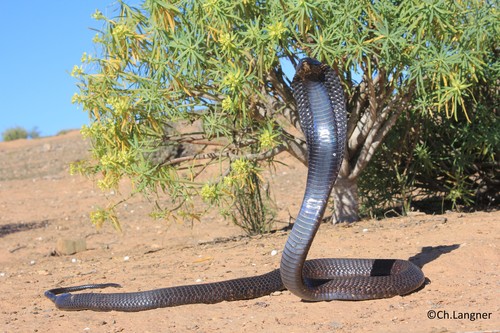
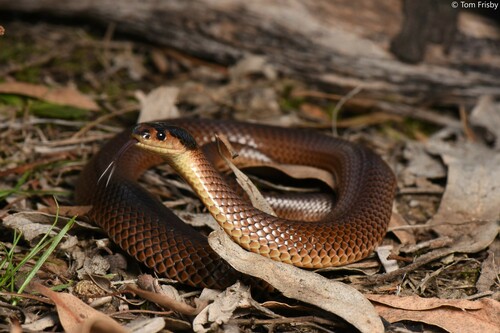
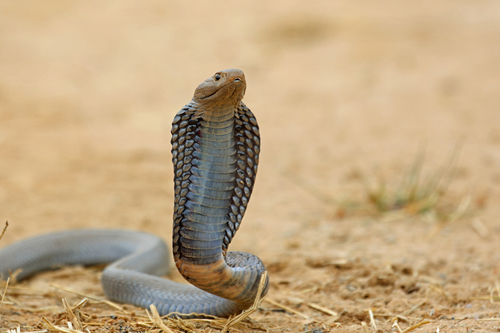
Naja nigricollis Reinhardt, 1843 is a moderately sized venomous snake with a moderately distinct head; the head shape comes primarily from two large venom glands, one on each side of the head. Its coloration varies depending on the region it comes from. Some specimens are black or pale grey with a yellow or reddish underside, a broad black neck band, and often an orange or pinkish bar on the neck. Other specimens are yellowish-brown or yellow copper, and lack the neck bands and reddish belly color. Additional specimens are deep reddish-brown, while others are olive brown. Some individuals even have black and white striping, or are completely solid white with dark eyes. At mid-body, this species has 21 to 23 dorsal scales, 182 to 196 ventral scales, and 54 to 66 subcaudal scales. Adults generally reach a total length of 1.2 metres (3.9 ft) to 2.2 metres (7.2 ft), and size follows trends based on geographic location and subspecies. This species is very common and widespread across most of sub-Saharan Africa, found in western, eastern, central, and parts of southern Africa. It is not present in the Congo Basin rainforests. Confirmed records of N. nigricollis exist from Angola, Benin, Burkina Faso, Cameroon, Central African Republic, Chad, Democratic Republic of the Congo (except the center), Congo, Ethiopia, Gabon, Ghana, Guinea Bissau, Guinea, Ivory Coast, Kenya, Liberia, Mali, Niger, Nigeria, Senegal, Sierra Leone, Gambia, Mauritania, Sudan, Tanzania, Somalia, Togo, Uganda, and Zambia. Older records of this species from South Africa, Botswana, Zimbabwe, Eswatini, Mozambique, or most of Namibia actually refer to Naja mossambica or Naja nigricincta, which were previously classified as subspecies of N. nigricollis. N. nigricollis most often lives in African savanna and semi-desert regions. It can be found at altitudes up to 1,800 metres (5,900 ft), and also occurs in moist savanna and cleared former forest areas of central Africa's tropical and subtropical regions, particularly near rivers and streams. Naja nigricollis is an adaptable snake; the nominate subspecies N. n. nigricollis lives in southeastern Nigeria, where its habitat has been converted from rainforest to human-made farmlands, plantations, suburban areas, and a small number of fragmented forests. This cobra species has benefited from the drastic changes to Nigeria's rainforests. A study by herpetologist Luca Luiselli indicates that this snake now forages in much drier microhabitats. The range of Naja nigricollis is currently expanding from southeastern Nigeria into the more desert-like, arid conditions of central Nigeria. It also inhabits coastal scrubs and dry grasslands. Like other cobra species, it may use abandoned termite mounds or rodent holes as hiding or cooling spots. Tree trunks appear to be its preferred hiding places. It is an excellent tree climber, so it may be arboreal at times. Because it is so common across Africa, it is often encountered in villages and small towns, where it may come into direct contact with people. Like other cobra species, Naja nigricollis is oviparous. Its mating season varies from the end of winter (September) to the beginning of summer (December), and this timing is generally consistent for both wild and captive individuals. Females usually lay 10 to 15 eggs per clutch, but clutch size can range from 8 to 22 eggs total. Gestation lasts approximately 90 to 100 days. After eggs are laid, they require a temperature of 28–30 °C (82–86 °F) to develop, and hatch after 60 to 70 days. Newly hatched young are around 20 to 25 centimeters (7.9 to 9.8 in) long and are fully independent at birth.