About Naja naja (Linnaeus, 1758)
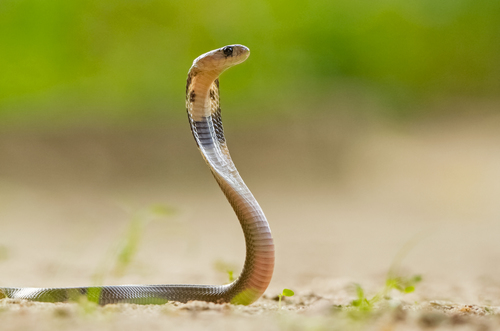
The Indian cobra (Naja naja) is a moderately sized, heavy-bodied cobra species. It is easily identifiable by its relatively large hood, which it expands when threatened. Many individuals have a characteristic hood mark on the dorsal (rear) surface of the hood. When present, this mark is made up of two circular ocelli patterns connected by a curved line, creating a shape that resembles spectacles. This species has an elliptical, depressed head that is only very slightly distinct from the neck. Its snout is short and rounded, with large nostrils; the eyes are medium-sized, and have round pupils. Most adult Indian cobras measure between 1 and 1.5 metres (3.3 to 4.9 ft) in length. Some individuals, particularly those from Sri Lanka, can reach 2.1 to 2.2 metres (6.9 to 7.2 ft), though this is very uncommon. The Indian cobra’s colour and pattern vary dramatically across its range. The ventral scales (underside) can be grey, yellow, tan, brown, reddish, or black. Dorsal scales may bear a hood mark or other colour patterns. The most common visible pattern is a posteriorly convex light band located at the level of the 20th to 25th ventrals. Salt-and-pepper speckles, especially on adult specimens, appear on the dorsal scales. Individuals, particularly those from Sri Lanka, may show poorly defined banding on the dorsum. Ontogenetic colour change (colour change with age) is often seen in individuals from the northwestern portion of the species’ range: southern Pakistan and northwestern India. In southern Pakistan, juvenile Indian cobras may be grey, and may or may not have a hood mark. In contrast, adults are typically uniformly solid black (melanistic) on their dorsal surface, while their underside is usually light outside the throat region. Patterns on the throat and ventral scales are also variable in this species. Most individuals have a light throat area followed by dark banding that spans 4–7 ventral scales. Adults also often have extensive mottling on the throat and venter, which makes the species’ patterns less clear than those seen in other cobra species. Except for northwestern specimens, most Indian cobras have a pair of lateral spots on the throat where the ventral and dorsal scales meet. The position of these spots differs by region: northwestern specimens have spots placed more anteriorly, while individuals from other parts of the range have spots placed more posteriorly. Analysis of transcriptomic data from 14 different tissues of the Indian cobra identified 19,426 expressed genes. Of these genes, 12,346 belong to the venom gland transcriptome, which includes 139 genes from 33 toxin gene families. Differential expression analysis found that 109 genes from 15 different toxin gene families are significantly up-regulated (with a fold change greater than 2) in the venom gland; this group includes 19 genes that are exclusively expressed in the venom gland. These 19 venom specific toxins (VSTs) encode the core effector toxin proteins of the venom: they include 9 three-finger toxins (six of which are neurotoxins, one cytotoxin, one cardiotoxin, and one muscarinic toxin), six snake venom metalloproteinases, one nerve growth factor, two venom Kunitz serine proteases, and a cysteine-rich secretory venom protein. In addition to these VSTs, other accessory venom proteins (AVPs) are also highly expressed in the venom gland: these include cobra venom factor (CVF), coagulation factors, protein disulfide isomerases, natriuretic peptides, hyaluronidases, phospholipases, L-amino acid oxidase (LAAO), vascular endothelial growth factor (VEGF), and 5' nucleotidases. This transcriptomic data, combined with information from the high-quality Indian cobra genome published by Susyamohan et al. in 2020, indicates that VSTs and AVPs together form the core toxic effector components of this venomous snake’s venom, which causes muscular paralysis, cardiovascular dysfunction, nausea, blurred vision, and hemorrhage after a snake bite. Identification of these genes that code for the core toxic effector components of Indian cobra venom may enable the development of recombinant antivenoms based on neutralizing antibodies for VST proteins. The Indian cobra is native to the Indian subcontinent, and occurs across India, Pakistan, Sri Lanka, Bangladesh, and southern Nepal. In India, its presence in the state of Assam and parts of Kashmir is unconfirmed, and it does not occur at altitudes over 2,000 metres (6,600 ft) or in extreme desert regions. In Pakistan, the species is absent from most of Balochistan province, parts of Khyber Pakhtunkhwa Province, other desert areas, and the Northern Areas. The westernmost confirmed record of the species is from Duki, Balochistan in Pakistan, while the easternmost confirmed record is from the Tangail District in Bangladesh. The species has been observed in Drosh, in the Chitral Valley, so it may also occur in the Kabul River Valley in extreme eastern Afghanistan. There has been at least one reported observation of this species in Bhutan. The Indian cobra lives in a wide variety of habitats across its range. It can be found in dense or open forests, plains, agricultural lands including rice paddy fields and wheat crops, rocky terrain, and wetlands, and it can even be found in heavily populated urban areas such as villages and city outskirts. It occurs from sea level up to 2,000 metres (6,600 ft) in altitude, and is absent from true desert regions. The Indian cobra is frequently found near water. Its preferred hiding spots are holes in embankments, tree hollows, termite mounds, rock piles, and small mammal dens. The Indian cobra is oviparous, and lays eggs between April and July each year. Females usually lay between 10 and 30 eggs in rat holes or termite mounds, and the eggs hatch after 48 to 69 days. Each newly hatched cobra measures 20–30 cm (8–12 in) in total length including the tail. Hatchlings are independent from birth, and already have fully functional venom glands.