About Naja kaouthia Lesson, 1831
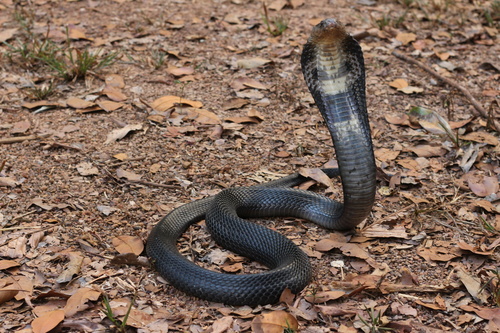
The monocled cobra (Naja kaouthia Lesson, 1831) can be distinguished from the Indian cobra by its characteristic O-shaped, or monocellate, hood pattern; the Indian cobra has a "spectacle" pattern made of two connected circular ocelli on the back of its hood. Elongated nuchal ribs allow cobras to expand the front part of their neck into the familiar "hood". Young monocled cobras have more consistent coloration than older individuals. The dorsal (upper) body surface can be yellow, brown, gray, or blackish, and may or may not have ragged or sharply defined cross bands. Overall, the upper body can range from olivaceous or brownish to black, and may or may not have a yellow or orange O-shaped marking on the hood. This species has a black spot on the underside of the hood on each side, plus one or two black cross-bars on the belly behind the hood area. The rest of the belly is usually the same color as the back, but paler. Monocled cobras become paler as they age, with adults typically being brownish or olivaceous. This species has a pair of fixed fangs at the front of the jaw. The largest recorded fang for this species measured 6.78 mm, or 0.678 cm. The fangs are moderately adapted for spitting venom. Most adult monocled cobras grow to a total length between 1.35 and 1.5 m (4.4 to 4.9 ft), with a tail length of 23 cm (9.1 in). While larger specimens have been recorded, they are rare; the maximum recorded total length for an adult is 2.3 m (7.5 ft). The monocled cobra's distribution extends from India in the west through China, Vietnam, and Cambodia. It also occurs on the Malay Peninsula, and is native to West Bengal, Bangladesh, Bhutan, Myanmar, Laos, Nepal, and Thailand. This species can adapt to a wide range of habitats, including both natural environments and areas altered by human activity. It prefers habitats associated with water, such as paddy fields, swamps, and mangroves, but it also lives in grasslands, shrublands, forests, and agricultural land up to elevations of 1,000 m (3,300 ft), as well as in human settlements including cities. The monocled cobra is a terrestrial species that is most active at dusk. In rice-growing regions, it hides in rodent burrows in the dykes between paddy fields and has adapted to a semi-aquatic lifestyle in these habitats. Juvenile monocled cobras feed mostly on amphibians, while adult individuals prey on small mammals, other snakes, and fish. When disturbed, this cobra prefers to escape. If threatened, it will raise the front portion of its body, spread its hood, usually hiss loudly, and strike in an attempt to bite in defense. It often hides in tree holes and areas with abundant rodent populations. Some populations of this species can spray venom, which has led to it being called the "Indian spitting cobra". The monocled cobra is an oviparous (egg-laying) species. Females lay clutches of 16 to 33 eggs. The incubation period for eggs ranges from 55 to 73 days. Egg laying occurs between January and March. Females usually remain with their eggs during incubation. Some collaborative behavior between males and females has been reported in hybrids between Naja naja and Naja kaouthia.