About Naja atra Cantor, 1842
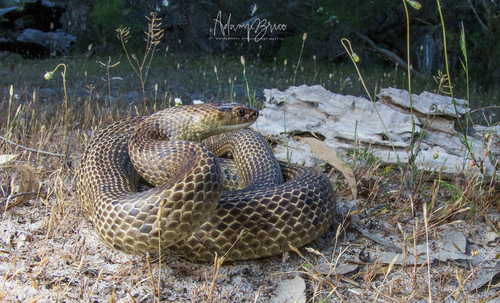
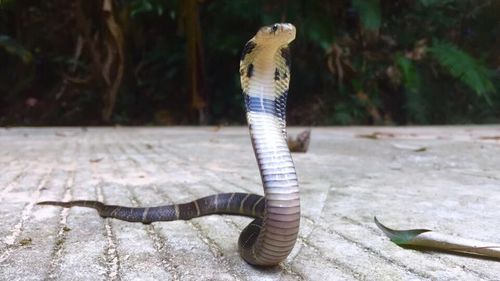
This is a medium-sized cobra commonly known as the Chinese cobra, with the scientific name Naja atra Cantor, 1842. Adults typically measure 1.2 to 1.5 meters (3.9 to 4.9 feet) in length; maximum growth to 2 meters (6.6 feet) is possible but rare. The shape of the hood mark is highly variable, and may take the form of a spectacle, mask, horseshoe, or O-shape. It is often connected to a light-colored throat area on at least one side. The throat itself has a distinct pale color, and usually has a pair of clearly defined lateral spots. The Chinese cobra can have an iridescent black dorsal base color marked with scattered, transverse double yellow lines. Its dorsal color is more often brown, grey, or black, which may or may not have narrow, irregularly spaced light transverse lines; these lines are especially prominent in juvenile individuals. The abdominal surface is colored pearl or slate grey. Like all elapids, this species is proteroglyphous, with permanently erect fangs located at the front of the upper jaw. The Chinese cobra is sometimes misidentified as the monocled cobra (Naja kaouthia). They can be easily distinguished by their lower ventral and subcaudal scale counts, a difference that is clearer when the individual's sex is accounted for. This species is distributed in southeastern China, including the provinces of Sichuan, Fujian, Guangdong, Guangxi, Guizhou, Hunan, Hubei, Zhejiang, Hong Kong, and the island province of Hainan, as well as Taiwan, northern Laos, and northern Vietnam. It is much more common in the southern portions of its range. Its typical habitats include woodlands, shrublands, grasslands, and mangroves, and it is an adaptable species that can survive in a wide variety of habitats. Like other cobra species, the Chinese cobra is oviparous. Gravid females lay between 6 and 23 eggs, with laying occurring any time from May to the end of July.